

AI-Powered Cyberattacks Are No Longer a Future Threat
Artificial intelligence has become one of the biggest opportunities in technology—and one of the fastest-evolving tools in cybersecurity. But the same capabilities that help businesses automate processes, analyze data, write software, and improve productivity can also help attackers move faster. Threat actors are already using AI to improve phishing campaigns, generate malicious code, conduct reconnaissance, analyze information, automate workflows, and adapt their operations. Google Threat Intelligence reported in 2026 that adversaries are moving toward the industrial-scale use of generative AI within cyber operations, including vulnerability discovery, exploit development, initial access, and operational support.
Microsoft has similarly reported that threat actors are operationalizing AI throughout the cyberattack lifecycle, while experimentation with agentic AI is beginning to enable more iterative decision-making and task execution. Microsoft notes, however, that fully agentic attacks are not yet operating at scale. That distinction is important. The threat isn’t necessarily an army of completely autonomous AI hackers today. The more immediate concern is that AI is compressing the time, cost, and expertise required to conduct cyberattacks. And that changes the defensive equation.
What Are AI-Powered Cyberattacks?
AI-powered cyberattacks are cyberattacks in which artificial intelligence is used to improve one or more stages of an attack. AI can help attackers process information, generate convincing communications, analyze code, automate repetitive tasks, identify potential vulnerabilities, or adapt attack workflows. Instead of replacing the attacker entirely, AI often acts as an accelerator. A conventional attacker may need hours to research a target, write a phishing message, analyze information, or modify a script. An AI-assisted attacker may be able to perform portions of those activities much faster and at greater scale. This creates a new cybersecurity challenge: The attack techniques may not be entirely new—but the speed, scale, personalization, and adaptability can be.
How AI Is Changing the Cyberattack Lifecycle
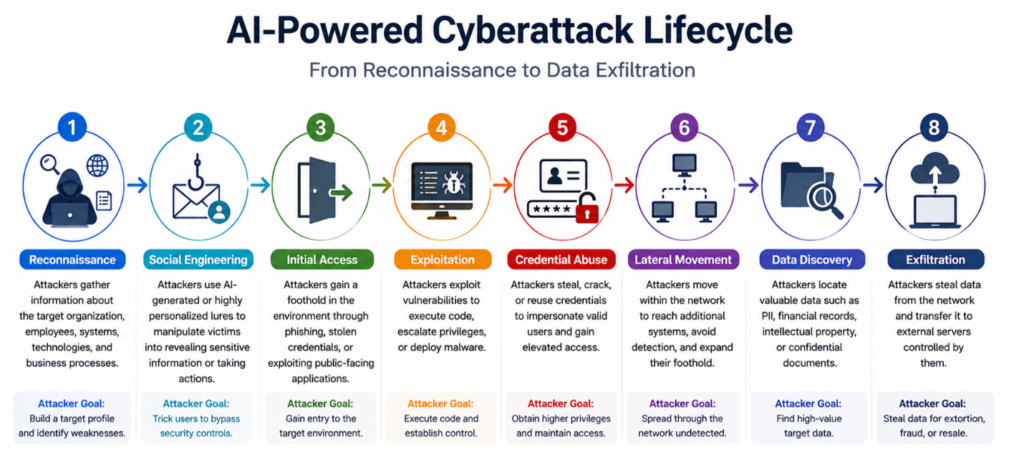
AI can potentially influence almost every stage of an attack:
Reconnaissance
AI can help attackers process publicly available information and organize target intelligence faster.
Phishing and Social Engineering
Generative AI can produce more convincing messages, adapt language to different audiences, and help attackers create highly personalized social-engineering campaigns. Microsoft has observed campaigns using popular AI brands such as ChatGPT, Copilot, DeepSeek, and Claude as phishing lures. One campaign Microsoft identified in May 2026 involved thousands of emails designed to collect personal and payment information.
Exploitation
AI can assist with vulnerability research, code analysis, and exploit development. Google Threat Intelligence reported in May 2026 that it had identified a threat actor using a zero-day exploit believed to have been developed with AI.
Post-Compromise Activity
Once attackers gain access, AI can potentially help analyze data, identify useful information, automate repetitive tasks, and support decision-making. The result is an attack environment where defenders may have minutes or hours to react to activity that previously took significantly longer to execute.
Are Fully Autonomous Threat Actors Already Here?
This is where cybersecurity discussions often become exaggerated. AI-assisted attacks are already real. Fully autonomous cybercriminal operations at scale are still an emerging capability. Microsoft’s 2026 threat intelligence research describes early experimentation with agentic AI, where models support iterative decision-making and task execution. However, Microsoft says these efforts remain limited by reliability and operational risks and have not yet been observed at scale. Google’s Mandiant research similarly describes a shift toward adaptive AI tools and agents that can navigate systems with less human oversight.
So businesses should not wait for a hypothetical “fully autonomous hacker.” The security problem has already started. The real near-term risk is AI-augmented threat actors operating faster and more efficiently than traditional security processes can respond to.
Why AI-Powered Attacks Are Harder to Defend Against
Traditional security programs often depend on predictable indicators, known attack patterns, and human analysts manually investigating alerts. AI can make attacks more dynamic. An attacker can potentially generate different phishing content for different targets, alter tactics quickly, automate reconnaissance, and process information at machine speed. This creates three major challenges.
Speed: Attackers can automate activities that previously required significant human effort.
Scale: One attacker can potentially target more organizations, users, or systems.
Adaptability: AI-assisted workflows can change based on information discovered during the attack.
The defensive implication is straightforward: Security teams cannot rely entirely on slow, manual detection and response processes. They need better telemetry, automation, behavioral detection, threat intelligence, and human expertise working together.
How Can Businesses Defend Against AI-Powered Cyberattacks?
The answer is not simply “use AI.” Organizations need to strengthen the fundamentals while using AI to improve defensive capabilities.
1. Strengthen Identity Security
AI-assisted phishing can make social engineering more convincing. Organizations should therefore prioritize phishing-resistant authentication, MFA, strong identity governance, least privilege, privileged-access management, and continuous monitoring of unusual account activity. A compromised identity can give an attacker access without requiring traditional malware.
2. Improve Vulnerability Management
AI can potentially accelerate vulnerability discovery and exploitation. Organizations need equally strong visibility into their own attack surface. Regular vulnerability assessments, penetration testing, patch management, and exposure monitoring can help identify weaknesses before attackers exploit them.
3. Monitor Behavior, Not Just Signatures
AI-assisted attacks may change rapidly enough that static indicators become less useful. Security teams should monitor behavioral signals such as unusual authentication, abnormal data access, privilege escalation, lateral movement, unexpected process activity, and suspicious network connections. Behavior-based detection can help identify attacks even when the exact malware or technique is unfamiliar.
4. Deploy Continuous Threat Detection
AI-powered attacks can operate outside normal business hours and move quickly. A 24/7 Security Operations Center (SOC) or Managed Detection and Response (MDR) capability can provide continuous monitoring, investigation, threat hunting, and response. Clear Infosec’s MDR service provides 24/7/365 monitoring, expert-led threat hunting, human-led alert prioritization, contextualization, reporting, and incident response capabilities.
5. Test Your Defenses Against Realistic Attacks
Organizations shouldn’t assume their security controls work simply because they are deployed. Penetration testing and Red Team exercises can simulate realistic attack paths and identify weaknesses across people, processes, technology, applications, networks, and cloud environments.
6. Prepare for AI-Driven Incident Response
Detection is only useful if the organization can respond quickly. Incident response plans should define how security teams investigate suspicious activity, isolate systems, protect evidence, disable compromised accounts, contain lateral movement, and recover operations. Clear Infosec provides incident response capabilities including 24/7 threat detection and response, expert-led threat hunting, and security preparedness services.
AI vs. AI: Can Artificial Intelligence Help Defend Against AI Attacks?
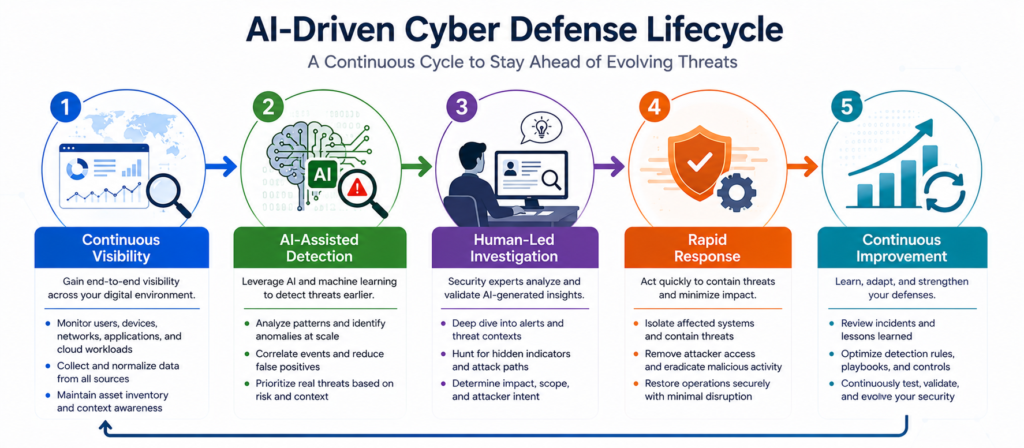
Yes—but AI should be viewed as an additional defensive capability, not a replacement for cybersecurity professionals. Security teams can use AI to help analyze large volumes of alerts, identify anomalies, correlate security events, accelerate investigation, summarize threat intelligence, and support threat hunting. The advantage is scale. A human analyst cannot manually examine every event generated across a modern enterprise. AI can help reduce that workload by identifying patterns and prioritizing events that deserve human attention. The strongest model is therefore not:
AI vs. Human
It is: AI + Security Analysts + Threat Intelligence + Automation
Human expertise remains critical for context, business impact, investigation, judgment, and response decisions.
Don’t Forget the New AI Attack Surface
There is another side to the problem. Businesses are increasingly deploying their own AI applications, copilots, AI agents, APIs, and third-party models. This creates a new attack surface. Google’s 2026 AI risk research identifies Shadow AI and limited visibility into AI assets as significant organizational risks. Organizations should therefore know:
Which AI systems are being used?
What data can they access?
Which tools can they call?
What permissions do their agents have?
Where is sensitive information being sent?
Who owns and monitors these systems?
An AI agent with excessive privileges can potentially become a high-impact security risk even if it was never designed to be malicious. AI security therefore needs to cover both sides: Defending against AI-powered attackers + Securing the organization’s own AI ecosystem
A Practical AI Cybersecurity Defense Strategy
Organizations preparing for AI-powered cyberattacks should focus on five areas:
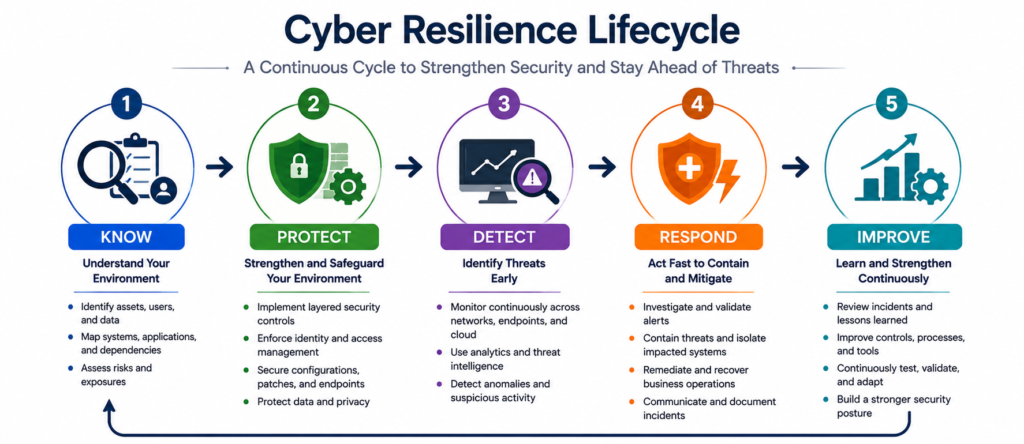
Know: Maintain visibility into users, devices, applications, cloud assets, AI systems, APIs, and third-party services.
Protect: Strengthen identity, access controls, vulnerability management, endpoint security, network segmentation, and data protection.
Detect: Use continuous monitoring, behavioral analytics, threat intelligence, SIEM, EDR/XDR, MDR, and threat hunting.
Respond: Maintain a tested incident response capability that can quickly investigate, contain, and recover from attacks.
Improve: Continuously evaluate controls through vulnerability assessments, penetration testing, Red Teaming, incident reviews, and security assessments.
How Clear Infosec Can Help Defend Against AI-Powered Threats
AI is changing the threat landscape, but the fundamentals of effective cybersecurity remain the same: visibility, prevention, detection, response, and resilience. Clear Infosec provides cybersecurity services designed to address these areas, including Managed Detection and Response, Incident Response, Threat Hunting, Vulnerability Assessment, Penetration Testing, Red Teaming, and Cyber Resilience Assessment. Organizations can use these capabilities to strengthen defenses against both conventional and AI-assisted threats. MDR and threat hunting can provide continuous visibility and proactive detection. Vulnerability Assessment and Penetration Testing can identify weaknesses that AI-assisted attackers could potentially exploit.
Incident Response and DFIR can help investigate and contain incidents when defenses are bypassed. Clear Infosec’s Breach Readiness Review also evaluates threat exposure, security controls, incident response readiness, and provides a roadmap for improving cyber resilience.
Explore Clear Infosec MDR Services →
Explore Clear Infosec Incident Response →
The Bottom Line: Don’t Wait for Autonomous Attackers
AI-powered cyberattacks are already changing how threat actors operate. The most immediate threat isn’t necessarily a completely autonomous hacker capable of independently running an entire campaign. It is the AI-augmented attacker who can research faster, personalize phishing, automate repetitive tasks, analyze vulnerabilities, generate code, and adapt operations more quickly than traditional attack methods allowed. Organizations that wait for fully autonomous threat actors to become commonplace may already be behind. The right strategy is to build defenses that can operate at the same speed as the threat:
AI is increasing the speed of cyberattacks. Your cybersecurity operations need to increase their speed too.
Talk to Clear Infosec About AI-Ready Cybersecurity →
Frequently Asked Questions
What are AI-powered cyberattacks?
AI-powered cyberattacks use artificial intelligence to improve activities such as reconnaissance, phishing, social engineering, vulnerability research, malware development, data analysis, and attack automation.
Are autonomous threat actors real?
AI-assisted threat activity is already being observed. Fully autonomous threat actors operating cyber campaigns independently at large scale are still an emerging capability. Current research shows increasing experimentation with agentic AI and reduced human involvement.
How is AI changing cybersecurity threats?
AI is increasing the speed, scale, personalization, and adaptability of cyber operations. Attackers can use AI to automate repetitive activities and improve phishing, reconnaissance, vulnerability research, and other stages of the attack lifecycle.
How can businesses defend against AI-powered cyberattacks?
Businesses should strengthen identity security, vulnerability management, endpoint protection, behavioral monitoring, threat intelligence, continuous security monitoring, MDR, threat hunting, penetration testing, and incident response.
Can AI help defend against AI-powered attacks?
Yes. AI can help security teams analyze large volumes of security data, identify anomalies, prioritize alerts, correlate events, and accelerate investigations. Human analysts remain essential for context, judgment, and response decisions.
What is the role of MDR against AI-powered attacks?
MDR provides continuous security monitoring, threat detection, expert-led threat hunting, alert investigation, and incident response. This can help organizations identify and respond to AI-assisted attacks faster.