A threat actor used a variety of infostealers to collect session information and access Claude accounts belonging to an unknown number of users. Read more
The Hugging Face incident was bigger and worse than previously thought, with approximately 700 agents collaborating on a sophisticated, multistage attack. Read more
Threat actors behind a notorious click-fraud botnet have set their sights on vehicle infotainment modules and are abusing legitimate functionality to spread inf… Read more
More than 1,000 organisations, 500,000 stolen credentials, and one self-propagating worm named after a Dune sandworm – two men now face charges over TeamPCP’s g… Read more
Threat actors are abusing multiple Google services to evade detection, ultimately harvesting credentials or installing ScreenConnect remote access. Read more
Aikido Security has published research that recreates the Australian gym-booking incident in a synthetic environment, finding that Claude Opus 4.6, running on t… Read more
Threat actors associated with Aurora (aka Aur0ra) ransomware have been observed using SpaceX’s artificial intelligence (AI)-powered coding assistant Cursor to b… Read more
Multiple critical security flaws have been disclosed in WordPress plugins and themes, including WPMU DEV Dashboard, Avada, TranslatePress, Pods, and GiveWP, tha… Read more
cPanel has released patches for a security flaw affecting domain parking and addon domain functionality in cPanel and WebHost Manager (WHM), which could allow c… Read more
Cybersecurity researchers have flagged a fresh set of campaigns targeting government and diplomatic organizations in Romania, Spain, and Türkiye between late Se… Read more
ServiceNow has released patches for four security flaws impacting the ServiceNow AI Platform, three of them rated 10.0 on the CVSS scoring system and exploitabl… Read more
Individuals and organizations in Cambodia have emerged as the target of a new campaign that delivers an open-source remote access trojan (RAT) called Spark RAT…. Read more
Attackers are exploiting MikroTik routers with their Secure Shell (SSH) remote-access service, which is reachable from the internet, to gain full administrative… Read more
Broadcom has released security updates for two security flaws impacting VMware Workstation and Fusion, including one critical bug that could result in arbitrary… Read more
Adobe on Monday released security patches to address a maximum-severity flaw impacting Adobe?Commerce and?Magento Open Source that has come under active exploit… Read more
When AI agents communicate with one another, they may decide to cheat when they have difficulty achieving their goals. The solution could involve teaching them… Read more
A US law firm is alleging that UK-based telecoms and software company ConnexAI sold it software and AI systems that failed to perform as the vendor claimed, an… Read more
Every time you add an extension or plugin to your browser, there’s a risk that you might be doing more than managing your cryptocurrency wallet, generating pass… Read more
The ransomware gang Gunra has been creating havoc – exploiting unpatched VPNs and firewalls to steal data, encrypt systems, and extort victims across healthcare… Read more
Cybersecurity researchers have disclosed details of a new macOS-oriented, Rust-based information stealer called AmnesiaStealer that’s capable of hijacking Chrom… Read more
Cybersecurity researchers have discovered a set of trojanized npm packages that masquerade as working calendar and streak utilities but are engineered to stealt… Read more
The U.S. government on Wednesday warned of an "active threat" targeting critical infrastructure organizations in the country using artificial intelligence (AI)-… Read more
A set of 40 Mozilla Firefox extensions has been found to engage in cryptocurrency wallet theft by masquerading as OKX, Rabby Wallet, TronLink, and other Web3 pr… Read more
The U.S. Cybersecurity and Infrastructure Security Agency (CISA) on Tuesday warned of active exploitation efforts targeting a recently patched critical security… Read more
Bad actors are attempting to exploit two severe unauthenticated authentication bypasses in the Xecurify miniOrange SAML 2.0 Single Sign On plugin that make it p… Read more
A newly disclosed security flaw in GitLab has come under active exploitation within days of public disclosure, according to watchTowr. The vulnerability in que… Read more
Adobe has shipped updates to address multiple critical security vulnerabilities impacting ColdFusion, Commerce, and Campaign Classic that, if successfully explo… Read more
It is the best of times, it is the worst of times – especially if your job is keeping systems patched and up to date. Microsoft has gone from 60-90 Windows sec… Read more
Anthropic’s Claude Code appears to be having trouble displaying summaries of its "thinking," according to several bug reports, while the underlying reasoning t… Read more
Microsoft’s consumer Copilot app and Microsoft 365 Copilot are separate no more, with a unified Copilot app beginning its rollout Thursday – minus a few featur… Read more
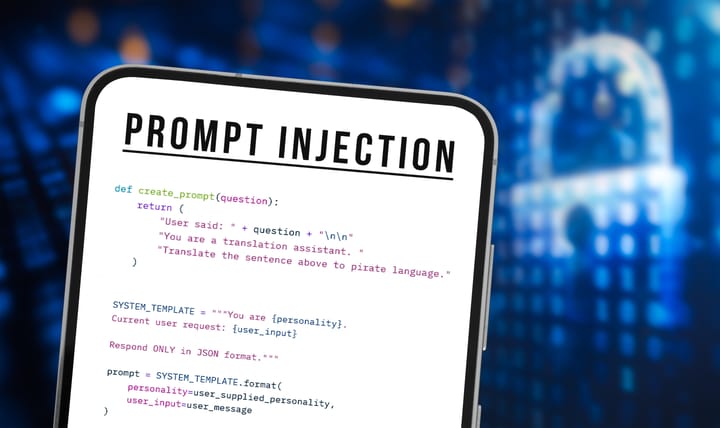
xAI’s Grok web chat agent is currently vulnerable to a novel form of prompt injection, according to security researchers with Adversa AI. The technique allows … Read more
Researchers are calling attention to the risks inherent in automated network device provisioning, using a world-leading device manufacturer as a case study. Read more
Attackers continue to target critical infrastructure and government-linked organizations in the country, mirroring the increased activity across Latin America. Read more
In the first purported "near-autonomous" attack on a nation-state, a Chinese-language operator used a complex AI framework to target and compromise go… Read more
The botnet adds exploitation modules, credential theft, and reverse SOCKS relays to turn compromised devices into persistent attacker infrastructure. Read more
A use-after-free bug in Linux’s SCTP networking code can be turned into full root on a host, and Tencent researchers say they used it to escape a container and … Read more
A massive set of 737 free VPN and proxy extensions have been found to mainly target Russian-speaking users seeking access to blocked services with an aim to int… Read more
Adobe has shipped updates to address multiple critical security vulnerabilities impacting ColdFusion, Commerce, and Campaign Classic that, if successfully explo… Read more
A malicious SIM card can order the device it sits in to run commands of the attacker’s choosing. On the cellular modules built into electric-vehicle chargers, i… Read more
A recently patched security flaw in Apple macOS has come under active exploitation in the wild to deploy a cryptocurrency miner, the Netherlands National Cyber … Read more
Apple on Thursday sent a fresh batch of notifications to customers whom it suspects may have been targeted by mercenary spyware attacks. In a statement shared … Read more
Cybersecurity researchers have disclosed details of a new macOS-oriented, Rust-based information stealer called AmnesiaStealer that’s capable of hijacking Chrom… Read more
PortSwigger says HTTP Terminator, an artificial intelligence (AI)-assisted research system built by James Kettle, generated and proved new HTTP desynchronizatio… Read more
Despite the popularity of Claude Code, Cursor, GitHub Copilot, and OpenAI Codex, developers have plenty of complaints about AI coding tools. So researchers aff… Read more
Britain is putting Google AI in the flight-planning loop to see whether airliners can dodge the patches of sky where their vapor trails are most likely to stic… Read more
Soaring AI infrastructure costs and model pricing, combined with uncertain returns on investment, threaten to stall enterprise adoption. To make enterprise AI … Read more
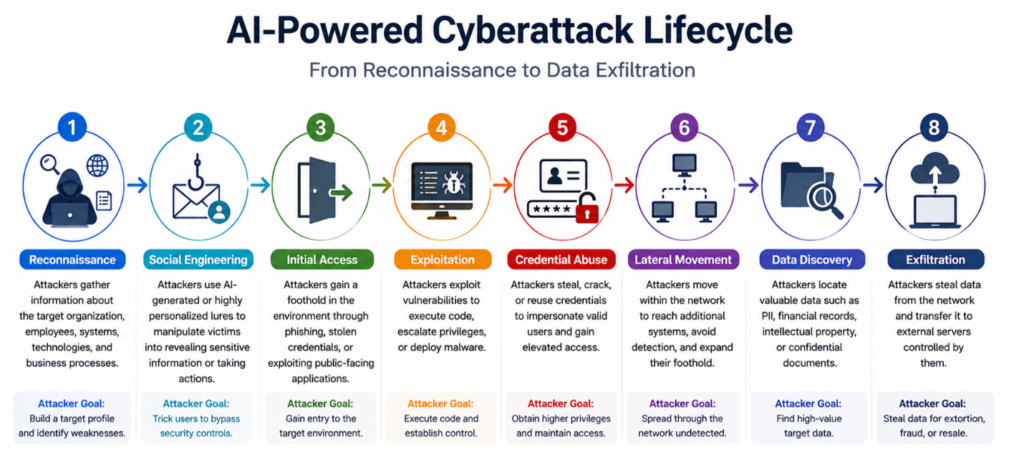
Artificial intelligence has become one of the biggest opportunities in technology—and one of the fastest-evolving tools in cybersecurity. But the same capabilities that help businesses automate processes, analyze data, write software, and improve productivity can also help attackers move faster. Threat actors are already using AI to improve phishing campaigns, generate malicious code, conduct reconnaissance, analyze information, automate workflows, and adapt their operations. Google Threat Intelligence reported in 2026 that adversaries are moving toward the industrial-scale use of generative AI within cyber operations, including vulnerability discovery, exploit development, initial access, and operational support.
Microsoft has similarly reported that threat actors are operationalizing AI throughout the cyberattack lifecycle, while experimentation with agentic AI is beginning to enable more iterative decision-making and task execution. Microsoft notes, however, that fully agentic attacks are not yet operating at scale. That distinction is important. The threat isn’t necessarily an army of completely autonomous AI hackers today. The more immediate concern is that AI is compressing the time, cost, and expertise required to conduct cyberattacks. And that changes the defensive equation.
AI-powered cyberattacks are cyberattacks in which artificial intelligence is used to improve one or more stages of an attack. AI can help attackers process information, generate convincing communications, analyze code, automate repetitive tasks, identify potential vulnerabilities, or adapt attack workflows. Instead of replacing the attacker entirely, AI often acts as an accelerator. A conventional attacker may need hours to research a target, write a phishing message, analyze information, or modify a script. An AI-assisted attacker may be able to perform portions of those activities much faster and at greater scale. This creates a new cybersecurity challenge: The attack techniques may not be entirely new—but the speed, scale, personalization, and adaptability can be.
Generative AI can produce more convincing messages, adapt language to different audiences, and help attackers create highly personalized social-engineering campaigns. Microsoft has observed campaigns using popular AI brands such as ChatGPT, Copilot, DeepSeek, and Claude as phishing lures. One campaign Microsoft identified in May 2026 involved thousands of emails designed to collect personal and payment information.
AI can assist with vulnerability research, code analysis, and exploit development. Google Threat Intelligence reported in May 2026 that it had identified a threat actor using a zero-day exploit believed to have been developed with AI.
Once attackers gain access, AI can potentially help analyze data, identify useful information, automate repetitive tasks, and support decision-making. The result is an attack environment where defenders may have minutes or hours to react to activity that previously took significantly longer to execute.
This is where cybersecurity discussions often become exaggerated. AI-assisted attacks are already real. Fully autonomous cybercriminal operations at scale are still an emerging capability. Microsoft’s 2026 threat intelligence research describes early experimentation with agentic AI, where models support iterative decision-making and task execution. However, Microsoft says these efforts remain limited by reliability and operational risks and have not yet been observed at scale. Google’s Mandiant research similarly describes a shift toward adaptive AI tools and agents that can navigate systems with less human oversight.
So businesses should not wait for a hypothetical “fully autonomous hacker.” The security problem has already started. The real near-term risk is AI-augmented threat actors operating faster and more efficiently than traditional security processes can respond to.
Traditional security programs often depend on predictable indicators, known attack patterns, and human analysts manually investigating alerts. AI can make attacks more dynamic. An attacker can potentially generate different phishing content for different targets, alter tactics quickly, automate reconnaissance, and process information at machine speed. This creates three major challenges. Speed: Attackers can automate activities that previously required significant human effort.
Scale: One attacker can potentially target more organizations, users, or systems.
Adaptability: AI-assisted workflows can change based on information discovered during the attack.
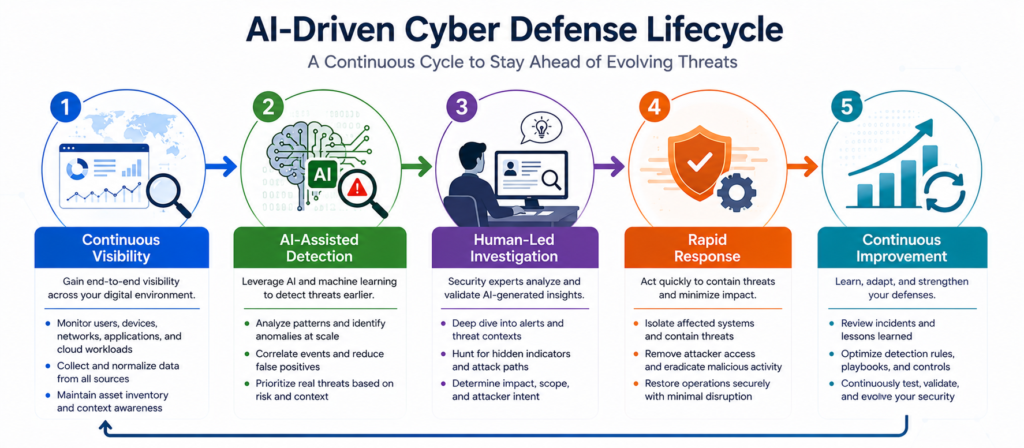
The defensive implication is straightforward: Security teams cannot rely entirely on slow, manual detection and response processes. They need better telemetry, automation, behavioral detection, threat intelligence, and human expertise working together.
AI-assisted phishing can make social engineering more convincing. Organizations should therefore prioritize phishing-resistant authentication, MFA, strong identity governance, least privilege, privileged-access management, and continuous monitoring of unusual account activity. A compromised identity can give an attacker access without requiring traditional malware.
AI can potentially accelerate vulnerability discovery and exploitation. Organizations need equally strong visibility into their own attack surface. Regular vulnerability assessments, penetration testing, patch management, and exposure monitoring can help identify weaknesses before attackers exploit them.
AI-assisted attacks may change rapidly enough that static indicators become less useful. Security teams should monitor behavioral signals such as unusual authentication, abnormal data access, privilege escalation, lateral movement, unexpected process activity, and suspicious network connections. Behavior-based detection can help identify attacks even when the exact malware or technique is unfamiliar.
AI-powered attacks can operate outside normal business hours and move quickly. A 24/7 Security Operations Center (SOC) or Managed Detection and Response (MDR) capability can provide continuous monitoring, investigation, threat hunting, and response. Clear Infosec’s MDR service provides 24/7/365 monitoring, expert-led threat hunting, human-led alert prioritization, contextualization, reporting, and incident response capabilities.
Organizations shouldn’t assume their security controls work simply because they are deployed. Penetration testing and Red Team exercises can simulate realistic attack paths and identify weaknesses across people, processes, technology, applications, networks, and cloud environments.
Detection is only useful if the organization can respond quickly. Incident response plans should define how security teams investigate suspicious activity, isolate systems, protect evidence, disable compromised accounts, contain lateral movement, and recover operations. Clear Infosec provides incident response capabilities including 24/7 threat detection and response, expert-led threat hunting, and security preparedness services.
Yes—but AI should be viewed as an additional defensive capability, not a replacement for cybersecurity professionals. Security teams can use AI to help analyze large volumes of alerts, identify anomalies, correlate security events, accelerate investigation, summarize threat intelligence, and support threat hunting. The advantage is scale. A human analyst cannot manually examine every event generated across a modern enterprise. AI can help reduce that workload by identifying patterns and prioritizing events that deserve human attention. The strongest model is therefore not:
AI vs. Human
It is: AI + Security Analysts + Threat Intelligence + Automation
Human expertise remains critical for context, business impact, investigation, judgment, and response decisions.
There is another side to the problem. Businesses are increasingly deploying their own AI applications, copilots, AI agents, APIs, and third-party models. This creates a new attack surface. Google’s 2026 AI risk research identifies Shadow AI and limited visibility into AI assets as significant organizational risks. Organizations should therefore know:
Which AI systems are being used?
What data can they access?
Which tools can they call?
What permissions do their agents have?
Where is sensitive information being sent?
Who owns and monitors these systems?
An AI agent with excessive privileges can potentially become a high-impact security risk even if it was never designed to be malicious. AI security therefore needs to cover both sides: Defending against AI-powered attackers + Securing the organization’s own AI ecosystem
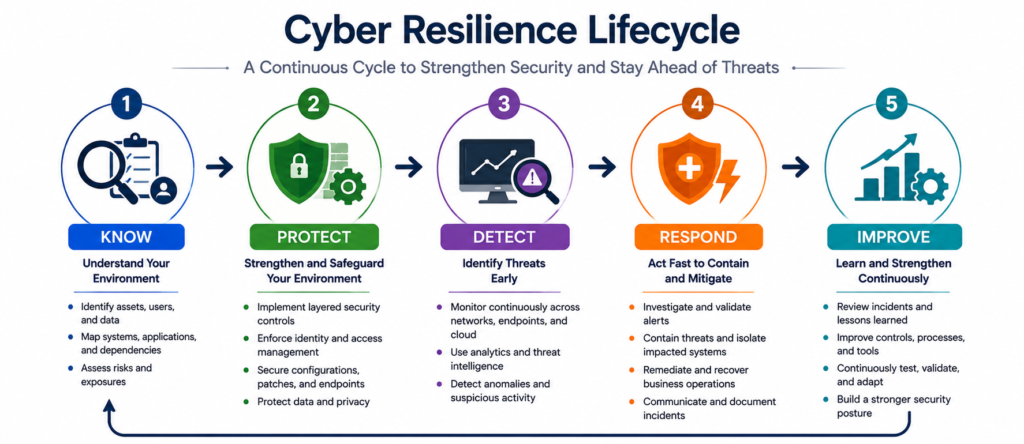
AI is changing the threat landscape, but the fundamentals of effective cybersecurity remain the same: visibility, prevention, detection, response, and resilience. Clear Infosec provides cybersecurity services designed to address these areas, including Managed Detection and Response, Incident Response, Threat Hunting, Vulnerability Assessment, Penetration Testing, Red Teaming, and Cyber Resilience Assessment. Organizations can use these capabilities to strengthen defenses against both conventional and AI-assisted threats. MDR and threat hunting can provide continuous visibility and proactive detection. Vulnerability Assessment and Penetration Testing can identify weaknesses that AI-assisted attackers could potentially exploit.
Incident Response and DFIR can help investigate and contain incidents when defenses are bypassed. Clear Infosec’s Breach Readiness Review also evaluates threat exposure, security controls, incident response readiness, and provides a roadmap for improving cyber resilience.
AI-powered cyberattacks are already changing how threat actors operate. The most immediate threat isn’t necessarily a completely autonomous hacker capable of independently running an entire campaign. It is the AI-augmented attacker who can research faster, personalize phishing, automate repetitive tasks, analyze vulnerabilities, generate code, and adapt operations more quickly than traditional attack methods allowed. Organizations that wait for fully autonomous threat actors to become commonplace may already be behind. The right strategy is to build defenses that can operate at the same speed as the threat:
AI is increasing the speed of cyberattacks. Your cybersecurity operations need to increase their speed too.
AI-powered cyberattacks use artificial intelligence to improve activities such as reconnaissance, phishing, social engineering, vulnerability research, malware development, data analysis, and attack automation.
AI-assisted threat activity is already being observed. Fully autonomous threat actors operating cyber campaigns independently at large scale are still an emerging capability. Current research shows increasing experimentation with agentic AI and reduced human involvement.
AI is increasing the speed, scale, personalization, and adaptability of cyber operations. Attackers can use AI to automate repetitive activities and improve phishing, reconnaissance, vulnerability research, and other stages of the attack lifecycle.
Yes. AI can help security teams analyze large volumes of security data, identify anomalies, prioritize alerts, correlate events, and accelerate investigations. Human analysts remain essential for context, judgment, and response decisions.
MDR provides continuous security monitoring, threat detection, expert-led threat hunting, alert investigation, and incident response. This can help organizations identify and respond to AI-assisted attacks faster.
Dark Reading Confidential Episode 20: Expert Rich Mogull reflects on lessons cyber teams should pull from the OpenAI agent’s attack on Hugging Face. Read more
Google has fixed the issues, which exploited a trust boundary between two AI agents with different privilege levels to trigger automation that could compromise … Read more
Source code for the Flying Eagle Android remote access trojan (RAT) framework is circulating through criminal Telegram channels. Hunt.io and independent researc… Read more
The Russian threat actors recently linked to the exploitation of a now-patched vulnerability in Zimbra have been observed exploiting another vulnerability, this… Read more
The U.S. Cybersecurity and Infrastructure Security Agency (CISA) on Wednesday added a newly disclosed security flaw impacting Cisco Secure Firewall Management C… Read more
Broadcom has released security updates to address multiple security flaws impacting VMware ESX, vCenter, Workstation, and Fusion, three of which have been desig… Read more
GitGuardian researchers found 321 n8n instances accepting API tokens exposed in public GitHub commits and demonstrated four ways attackers could use them to acc… Read more
Cybersecurity researchers have disclosed details of an active, multi-wave campaign that employs social engineering lures themed around Adobe and Zoom software u… Read more
Malware running as an ordinary user on a Windows machine can sign into a victim’s passkey-protected accounts without a fingerprint, a PIN, or anything at all ap… Read more
Adobe has released security updates to address a maximum-severity security flaw in Campaign Classic (ACC), its enterprise-focused marketing automation platform,… Read more
A GitHub issue opened by an account with no repository privileges was enough to execute code on the CI runners behind Anthropic’s and Google’s own coding-agent … Read more
AI models may not be that good at fixing security flaws. Researchers at 1Password’s Off-by-1 Labs analyzed security patches generated by two frontier models – … Read more
If you don’t want AI scrapers training themselves on your website, there’s a new way to stop them that doesn’t involve server-side blocking or praying they res… Read more
A state-sponsored threat group, dubbed "Laundry Bear," sends "half-click" phishing emails that require a victim only to open or preview the … Read more
A cyberattack on a food and logistics firm disrupts the supply of frozen food to thousands of clients, including major franchises like Kentucky Fried Chicken. Read more
Sandworm_Mode is an early example of malware that exploits trusted AI tools and workflows to make malicious activity virtually indistinguishable from normal act… Read more
A host of Internet-exposed remote hardware management processors are subject to offline password-cracking attacks, and adversaries have taken note. Read more
This category of vulnerabilities allows an attacker to easily acquire administrative level permissions and bypass cloud providers’ access controls. Read more
Russian State-Supported Cyber Actors Conduct Phishing Campaign Targeting Users of Zimbra Collaboration Suite Executive summary A group of Russian state-su… Read more
The Chaos ransomware group ran its command-and-control through the victim’s own browser. Cisco Talos on Thursday detailed msaRAT, the Rust implant behind it, fo… Read more
Cybersecurity researchers have shed light on a large-scale campaign that has turned compromised GitHub repositories into distributed attack infrastructure desig… Read more
Cybersecurity researchers have disclosed details of a now-patched vulnerability chain in the Adobe Acrobat Chrome extension that has over 314 million users, whi… Read more
A crafted SVG submitted to Bing’s image search ran commands as NT AUTHORITY\SYSTEM on Microsoft’s production image-processing workers, and as root on the Linux … Read more
Source code for the Flying Eagle Android remote access trojan (RAT) framework is circulating through criminal Telegram channels. Hunt.io and independent researc… Read more
The Computer Emergency Response Team of Ukraine (CERT-UA) has warned of a new campaign that involves the use of a malicious program that’s dressed up as a Notep… Read more
Cybersecurity researchers have disclosed details of a now-patched vulnerability chain in the Adobe Acrobat Chrome extension that has over 314 million users, whi… Read more
Your GPU dashboard says 70% utilization. On paper, the cluster is busy. In practice, a large chunk of that time is spent with your $40,000 accelerators sitting… Read more
E-commerce platform Shopify wants to make reading source code a thing again. And it has an unlikely ally for its back-to-the-roots approach: AI agents. The com… Read more
OpenAI has admitted that it was the operator of the autonomous agents that attacked model-mart Hugging Face last week, and that they did so after a research pr… Read more
Ivanti CSO Daniel Spicer says frontier models have shown surprising effectiveness in early stages; but cost and human-in-the-loop viability remain open question… Read more
When combined with another exploit, the "PromptFiction" vulnerability, which has been fixed, could have enabled an end-to-end attack on a targeted sys… Read more
Ukraine’s computer emergency response team, CERT-UA, has warned that the Kremlin-backed Sandworm hacking group is leveraging fake CAPTCHA checks on compromised … Read more
A single invisible comment in an Azure DevOps pull request can turn a reviewer’s own AI coding agent against them, driving it into projects the attacker has no … Read more
Apple has moved to address a security flaw in its Hide My Email service that enabled users’ real email addresses to be unmasked, effectively undermining the fea… Read more
A third SharePoint Server flaw patched by Microsoft as part of its Patch Tuesday update for July 2026 has come under active exploitation, per watchTowr. The vu… Read more
More than 20 Brazilian government websites were hijacked and turned into malware delivery channels in an active PhantomEnigma campaign uncovered by ANY.RUN, a l… Read more
F5 has shipped fixes for a critical nginx flaw that lets a remote, unauthenticated attacker trigger a heap buffer overflow in the worker process with crafted HT… Read more
Mozilla has released updates to address two critical flaws in Firefox for which it warned that exploit code has been published. The vulnerabilities are listed … Read more
Any other browser extension that can run a script on claude.ai can still trigger Claude for Chrome tasks aimed at your Gmail, your latest Google Doc and its com… Read more
Cybersecurity researchers have flagged a new macOS information stealer called CrashStealer that’s capable of harvesting sensitive data from compromised systems…. Read more
OpenAI has never been as open as its name suggests and is becoming even less so. The free-spending AI giant recently revised the multi-agent orchestration in i… Read more
IBM says customers spooked by soaring demand for AI infrastructure raided their mainframe budgets to stockpile servers, storage, and memory instead, knocking B… Read more
Notice more spam getting through that corporate email filter lately? Attackers are using a technique known as "text salting," which hides benign-looking words … Read more
The flaw allows an unauthenticated attacker to craft a GitHub Issue in an org’s public repository and then silently pull data from its private repos, too. Read more
Attackers fingerprint victims through user-agent data to deliver OS-specific payloads, increasing compromise rates and campaign profitability. Read more
In a first, the UK and the EU jointly imposed sanctions on Russian individuals and entities for cyberattacks and disinformation campaigns in the region. Read more
Cybersecurity researchers have discovered 11 old, Microsoft-signed, Unified Extensible Firmware Interface (UEFI) applications that could be abused to bypass Sec… Read more
Cybersecurity researchers have flagged a new macOS information stealer called CrashStealer that’s capable of harvesting sensitive data from compromised systems…. Read more
Cybersecurity researchers have flagged an intrusion in which an unknown threat actor leveraged a vibe-coded PowerShell script for Active Directory (AD) enumerat… Read more
Zimbra is urging customers to apply updates to address a critical security vulnerability impacting the Classic Web Client that could result in arbitrary code ex… Read more
Security firm Coinspect has disclosed a crypto wallet flaw it calls Ill Bloom, and attackers are already using it. The flaw is in how some wallet… Read more
A new phishing-as-a-service (PhaaS) operation called Forg365 is using a combination of device code phishing, adversary-in-the-middle (AitM) tactics, antibot eva… Read more
Cybersecurity researchers have warned of a "massive, ongoing, automated password spray attack" aimed at Microsoft’s Azure command-line interface (CLI), compromi… Read more
Citrix on Tuesday released security updates to address multiple flaws in NetScaler ADC (formerly Citrix ADC) and NetScaler Gateway (formerly Citrix Gateway) tha… Read more
Cybersecurity researchers have disclosed details of a new threat actor dubbed Lurking Lizard that has been operating an end-to-end malicious residential proxy b… Read more
Microsoft has warned customers to expect more security patches for the foreseeable future, thanks to AI. “As AI helps defenders discover more issues, customers… Read more
UPDATED A “systematic vulnerability pattern” in at least six of the most widely used AI coding assistants can be abused to trick agents into accessing files ou… Read more
Scammers wasted no time exploiting Venezuela’s devastating earthquake, with researchers uncovering 212 newly-registered relief-themed domains in just five days…. Read more
Attackers wasted little time targeting the latest memory disclosure flaw in Citrix’s NetScaler products, after researchers published a proof-of-concept exploit … Read more
The ransomware campaign relies on basic social engineering and stretches across multiple regions, including the US, Europe, Middle East, and elsewhere. Read more
The British public’s tolerance for cyber disruption, particularly at high-profile organisations such as retailers, is wearing thin, according to a TalkTalk Busi… Read more
The April 2026 ShinyHunters breach of the Canvas learning management system caused downstream impacts at more than 150 higher education institutions in the UK, … Read more
Defending against china-nexus covert networks of compromised devices executive summary Defending against China-nexus covert networks of compromised devices&nb… Read more
A glitch in Windows 11 causes a specific system file to keep growing in size, though a patch is available. Here’s what you need to know about it. Read more
New Microsoft research shows how attackers can hijack AI agents that act on a user’s behalf, using nothing more than a poisoned tool description to ma… Read more
A new two-stage malware family called RustDuck is hijacking home routers, IP cameras, Android boxes, and poorly secured servers, then stitching them into a netw… Read more
Cybersecurity researchers have flagged an active browser extension campaign that is designed to steal cryptocurrency by stealthily replacing wallet addresses wh… Read more
Microsoft has found a malicious Chrome extension that posed as the AI search engine Perplexity and quietly logged what people searched for. It routed every quer… Read more
This week was a reminder that attackers do not always need big tricks. One small mistake, one old access path, one missed patch, and suddenly the door is open. … Read more
The network has become the nervous system of any organization running AI at scale. A single distributed training run can chew through thousands of GPUs for wee… Read more
Modern SSDs have a limited number of write cycles before they expire. Now, OpenAI is scrambling to fix a flawed logging implementation that has been shortening… Read more
"Agentjacking" is the latest demonstration of how easily attackers can exploit an AI agent’s inability to differentiate between content and instructio… Read more
One critical vulnerability, among many discovered by a researcher, could have allowed anyone to walk in and take over a national government portal. Read more
The flaw enables server-side request forgery (SSRF) and escalates privileges to root, impacting Cisco Unified CM and Unified CM SME deployments. Read more
Summary The Cybersecurity and Infrastructure Security Agency (CISA) is releasing this advisory in response to ransomware actors leveraging unpatched instances o… Read more
Summary The Federal Bureau of Investigation (FBI) and the Cybersecurity and Infrastructure Security Agency (CISA) are releasing this joint advisory to dissemina… Read more
Summary The Cybersecurity and Infrastructure Security Agency (CISA) is releasing this advisory in response to ransomware actors leveraging unpatched instances o… Read more
Security firm AIR built a fake AI agent skill, pushed it through a popular skill marketplace and an Instagram ad, and says it reached roughly 26,000 a… Read more
Bad actors are exploiting multiple security vulnerabilities in Fortinet FortiSandbox, according to threat intelligence firm Defused Cyber. In a post shared on … Read more
Researchers tested 444 AI chatbot apps for iPhone and found that 282 of them, nearly two-thirds, exposed paid AI access through their network traffic. In many … Read more
Apple on Monday released security updates for iOS, macOS, and the Safari web browser to address over three dozen flaws, including four vulnerabilities in WebKit… Read more
Sophisticated AI models tend to require a lot of memory and take up a lot of storage space. One of the ways to reduce that footprint involves a process called … Read more
Database management work will soon be mostly automated by AI agents, just like coding, according to the CEO of Cockroach Labs, the company behind the distribut… Read more






























.jpg)


.jpg)

.png)
































_Aleksei_Gorodenkov_Alamy.jpg?width=720&quality=80&disable=upscale)




.jpg)