

Why LLMjacking Matters
Organizations are rapidly adopting large language models (LLMs) across customer support, software development, analytics and internal business operations. As AI services become part of everyday business workflows, the credentials and cloud permissions that enable these services are becoming valuable targets for cybercriminals.
A compromised AI credential can create more than a data-security problem. It can allow an attacker to consume expensive model resources, create additional API keys, access connected cloud services and generate fraudulent usage charges against the victim’s account.
Google Threat Intelligence Group (GTIG) and Mandiant reported (in research published November 2, 2026) LLMjacking incidents involving organizations across several industries. Their reporting described fraudulent charges exceeding $100,000 in a single day and cumulative costs reaching $1 million at some organizations before access was revoked. The activity also highlights underground services known as LLM Mixers, which aggregate and resell unauthorized access to AI models. Mandiant’s 2026 cases spanned financial services, retail, technology and transportation organizations in North America, South America and Asia Pacific.
The key takeaway is clear: AI API keys, cloud identities, model gateways and usage permissions must be treated as critical business assets.
What Is LLMjacking?
LLMjacking is the unauthorized use and monetization of access to cloud-hosted large language models. Rather than attacking the AI model itself, threat actors target the credentials and infrastructure that allow an organization to access it.
Commonly targeted access paths include:
- Cloud IAM credentials and service-account keys.
- LLM API keys exposed in source-code repositories or application configuration.
- Personal Access Tokens (PATs) and active session tokens.
- Publicly exposed model endpoints and weakly protected AI gateways.
- Overprivileged identities and integrations connected to AI services.
Once access is obtained, attackers may invoke premium models, generate additional credentials, provision cloud resources or route requests through proxy infrastructure. The victim organization may continue paying for this activity until the compromise is detected and contained.
The LLMjacking Attack Chain
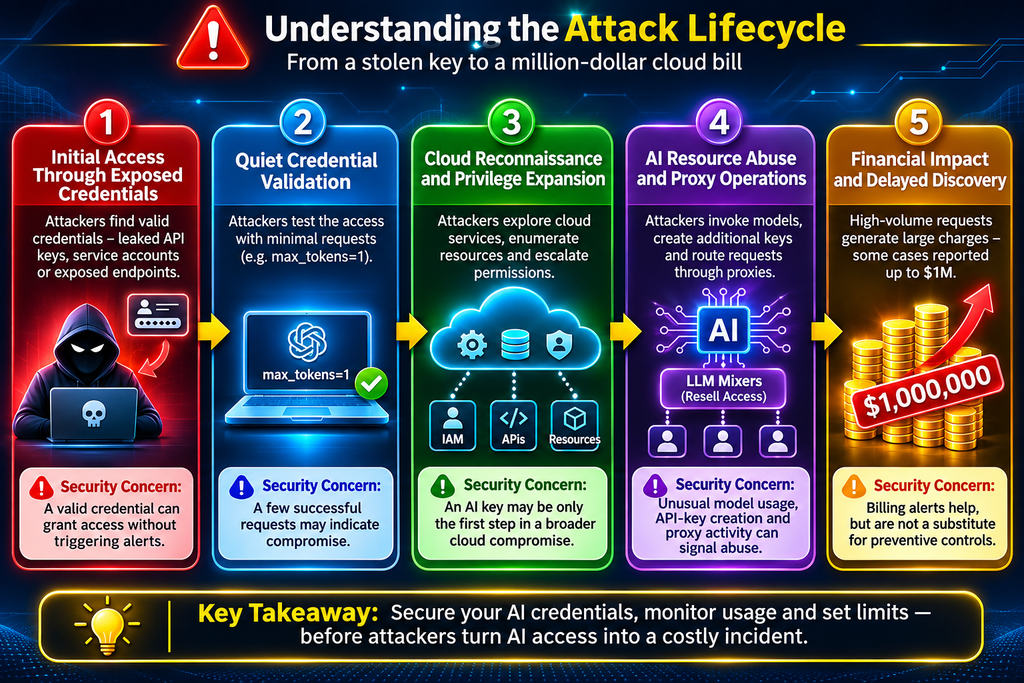
Stage 1: Initial Access Through Exposed Credentials
Technique
The attacker obtains valid identity material, such as IAM access keys, service-account keys, GitHub personal access tokens, session tokens or LLM API keys. They may also find a model endpoint with no authentication.
Observed Activity
- Sysdig, 2024: credentials came from a host running a Laravel version vulnerable to CVE-2021-3129.
- Sysdig, November 2025 AWS intrusion: credentials found in public S3 buckets holding data for AI models.
- Google, 2026: LLM API keys harvested from public GitHub repositories.
Security Concern
The access is authenticated, so there is no exploit or malware signature to detect.
Progression: The attacker tests whether the credential works.
Stage 2: Quiet Credential Validation
Technique
The attacker sends minimal inference requests to learn which models and quotas the key can reach, without creating volume or cost.
Observed Activity
- Google: automated single-token requests, including max_tokens=1.
- Sysdig, 2024: InvokeModel calls with an invalid parameter. A ValidationException meant the key had model access; AccessDenied meant it was restricted.
- Sysdig, 2024: a script that tested stolen keys against ten AI services.
Security Concern
Volume-based alerts miss this stage. Correlate model activity with identity, source, time and expected application behavior, and treat a ValidationException on InvokeModel as a reconnaissance signal.
Progression: With a working key confirmed, the attacker expands access.
Stage 3: Cloud Reconnaissance and Privilege Expansion
Technique
The attacker enumerates IAM, services, repositories, secrets and model resources, then escalates privileges and establishes persistence.
Observed Activity
- Sysdig AWS case: Lambda function code injection, administrator privileges in under 10 minutes, 19 AWS identities used and a backdoor admin user created.
- Sysdig: a GetModelInvocationLoggingConfiguration call to check logging before models were invoked.
- Google: unauthorized IAM accounts, injected SSH keys and additional API keys; UNC6993 accumulated over $100,000 in billing charges.
Security Concern
An exposed AI key may be only the first step in a broader cloud compromise. Lambda update permissions are an escalation path, and Amazon Bedrock model invocation logging is disabled by default.
Progression: The attacker now has enough control to use and resell the access.
Stage 4: AI Resource Abuse and Proxy Operations
Technique
The attacker invokes premium models, enables additional services, creates extra API keys and runs proxy infrastructure that routes requests through compromised accounts.
Observed Activity
- Google: a follow-on actor exploited a LiteLLM gateway’s /key/regenerate endpoint (CVE-2026-40217) to raise ordinary virtual keys to administrator level.
- Google: the LLM Mixer Jet Night advertised an unlimited plan for about $60 a month; Google believes such pricing depends on stolen keys.
Security Concern
Unusual model enablement, API-key creation, quota changes, GPU provisioning and outbound proxy activity can indicate that an account is being repurposed.
Progression: The victim’s account carries all of the usage.
Stage 5: Financial Impact and Delayed Discovery
Technique
Sustained inference and GPU use is billed to the account owner until credentials are revoked, unauthorized workloads are stopped and the environment is secured.
Observed Activity
- Google: more than 500,000 API calls in under eight hours, with nearly $1 million in token costs passed to the victim organization.
Security Concern
Billing alerts are important, but they are not a substitute for preventive quotas, access restrictions and rapid incident response.
Progression: The charges continue until the victim detects the activity and revokes access.
What Organizations Should Prioritize
1. Enforce Usage and Spending Controls
- Configure model-specific quotas, request limits and spending thresholds.
- Monitor unusual token consumption and cloud resource usage.
- Restrict premium model access and establish escalation procedures.
2. Protect API Keys and Credentials
- Store secrets securely and enable automated secret scanning.
- Avoid exposing API keys in source code, scripts and configurations.
- Rotate compromised keys and revoke unused credentials.
3. Strengthen Identity and Access Management
- Enforce MFA and least-privilege access.
- Restrict API-key creation and modification to authorized users.
- Monitor suspicious IAM changes and unauthorized account creation.
4. Improve Logging and Threat Detection
- Enable AI model-invocation and cloud audit logging. Amazon Bedrock model invocation logging, for example, is disabled by default.
- Monitor unusual model requests, key creation and permission changes.
- Correlate AI activity with identity, network and application logs.
5. Secure Shadow AI Infrastructure
- Identify unauthorized AI services, endpoints and gateways.
- Review exposed interfaces, third-party integrations and permissions.
- Patch AI gateways and restrict unnecessary outbound connections.
Conclusion
LLMjacking turns compromised credentials into a direct financial and operational risk. A stolen key can enable unauthorized model usage, expose connected cloud resources and generate substantial charges before an organization recognizes the activity.
The controls that protect cloud environments (least privilege, secrets management, strong authentication, logging, monitoring and incident response) also help protect AI services. They must, however, be applied deliberately to model endpoints, AI gateways, service identities and usage limits.
At Clear Infosec, we believe securing AI infrastructure requires continuous visibility into identities, exposed endpoints, access permissions and service configurations. Proactive security assessments, continuous monitoring and a rehearsed incident-response process can help organizations identify weaknesses before attackers turn unauthorized AI access into a costly incident.