
Introduction & Targeting
A novel ransomware strain known as Charon has surfaced, specifically targeting critical infrastructure in the Middle East—namely, the public sector and aviation industry.

Fig1: Overview of Charon ransomware’s infection chain and attack flow
Analysts note that Charon exhibits unmistakable Advanced Persistent Threat (APT) hallmarks, such as DLL sideloading, process injection, and anti-EDR (Endpoint Detection & Response) evasion techniques, signaling a troubling shift in ransomware sophistication.
Attack Chain: From Legitimate Binary to Malicious Payload
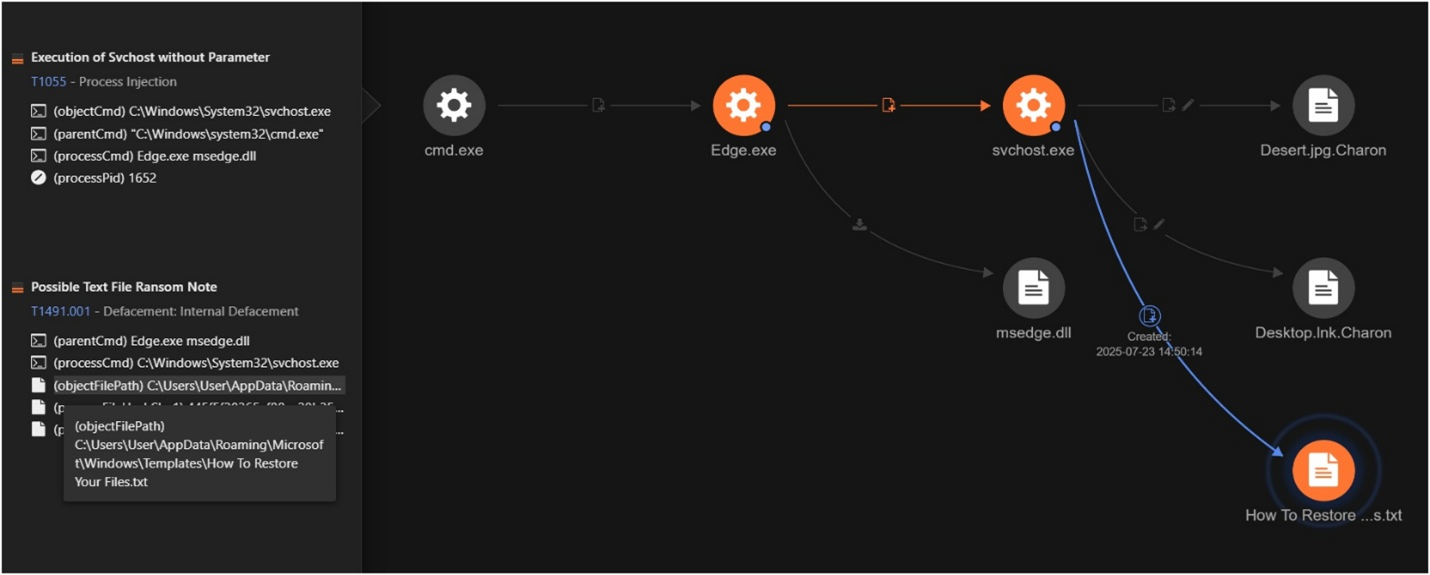
Fig2: Attack chain of Charon ransomware from legitimate binary execution to malicious payload deployment.
-
Abuse of Trusted Executables
The intrusion begins when attackers execute a legitimate Windows binary,Edge.exe(originally dubbedcookie_exporter.exe), to sideload a malicious DLL namedmsedge.dll—also known by its internal codename SWORDLDR. -
Encrypted Multi-Stage Payload Loading
SWORDLDR loads a seemingly innocuous fileDumpStack.log—initially missing from telemetry but later recovered—that contains encrypted shellcode. This shellcode undergoes multi-stage decryption: first revealing an intermediate payload with embedded configuration directives (such as targetingsvchost.exefor injection), and then fully unpacking the Charon ransomware executable (PE).
-
Process Injection for Stealth
The decrypted payload is stealthily injected into a newsvchost.exeprocess, enabling impersonation of a legitimate service to evade endpoint security mechanisms.
-
Disabling Defenses & Destroying Recovery Artifacts
Prior to encryption, Charon disables security services, corrupts or deletes shadow copies, and empties the Recycle Bin—actions aimed at thwarting recovery attempts. -
Partial File Encryption for Speed
Leveraging a hybrid cryptographic method with Curve25519 ECC and ChaCha20, Charon employs a partial encryption strategy. Smaller files (≤ 64 KB) are fully encrypted; medium files have selective chunks encrypted; larger files are handled in evenly distributed chunks—an approach that balances speed and file disruption . -
Network Propagation
Charon aggressively scans for and encrypts network shares—excludingADMIN$—using NetShareEnum and WNetEnumResource APIs. It targets both mapped drives and UNC paths to maximize impact. -
Dormant Anti-EDR Driver
Inside its data section, Charon contains a driver (e.g.,WWC.sys), derived from the open-source Dark-Kill project, designed to disable EDR via a BYOVD (Bring Your Own Vulnerable Driver) tactic. Notably, this module remains inactive in current versions—likely reserved for future use.
Targeted Theft & Ransom Messaging
Charon’s ransom notes are meticulously customized—they explicitly reference the victim organization by name and often include a list of encrypted files along with tailored payment instructions. This approach underscores a targeted rather than opportunistic modus operandi.
Attribution & APT-Style Convergence
The technical execution of Charon—particularly the DLL sideloading workflow—mirrors what is seen in campaigns attributed to the China-linked APT group Earth Baxia (also known as APT41, Wicked Panda). Nonetheless, researchers stop short of definitive attribution. They outline three possibilities:
-
Direct involvement by Earth Baxia
-
A deliberate mimicry or false-flag operation
-
An independently developed but similar playbook
At present, there’s no conclusive infrastructure overlap to confirm attribution.
This merging of APT-level tactics with ransomware reflects a dangerous evolution—ransomware actors are adopting stealth, precision, and persistence, raising the stakes for defenders.
Defensive Recommendations
To counter this sophisticated threat, security teams should consider the following multilayered defenses:
-
Harden Execution Policies
Restrict which executables are permitted to load DLLs, especially in commonly abused directories. Monitor chains likeEdge.exe → suspicious DLL → svchost.exeand flag unvalidated DLLs placed next to signed binaries. -
Strengthen Endpoint Controls
Ensure that EDR and antivirus agents cannot be tampered with, disabled, or uninstalled by malicious actors. -
Isolate Sensitive Resources
Restrict lateral movement by safeguarding network shares and disabling admin shares likeADMIN$. Use robust authentication controls for remote access. -
Robust Backup Strategy
Maintain offline or immutable backups that can’t be compromised by malware. Regularly test backup restores and centralize backup permissions to trusted, monitored accounts. -
Educate and Limit Privileges
Train staff to recognize phishing and suspicious payloads. Enforce least privilege principles to reduce the attack surface and limit the impact of a breach. -
Proactive Detection via IOCs
Leverage threat intelligence platforms (e.g., Trend Vision One) to hunt for Charon-related indicators and deploy tailored detection rules.
Conclusion
Charon marks a worrying trajectory in ransomware evolution. By borrowing techniques from APT playbooks—such as stealthy DLL sideloading, multi-stage encryption, customized ransom demands, and latent anti-EDR capabilities—it blurs the line between cyber espionage and cyber extortion.
Organizations in high-risk sectors—especially within the Middle East—must urgently reevaluate their posture. The fusion of APT-level stealth and rapid destructive capability makes this a formidable adversary. Only an equally adaptive, layered defense strategy can hope to keep pace.
References
-
The Hacker News – Charon Ransomware Hits Middle East Critical Infrastructure
https://thehackernews.com/2025/08/charon-ransomware-hits-middle-east.html -
Dark Reading – Charon Ransomware Uses APT-Style Tactics to Target Middle East
https://www.darkreading.com/threat-intelligence/charon-ransomware-apt-tactics