
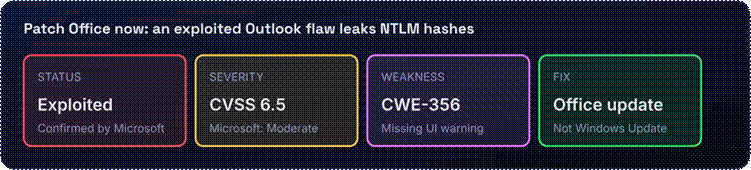
Figure 1. CVE-2026-124194 at a glance
Why this issue matters
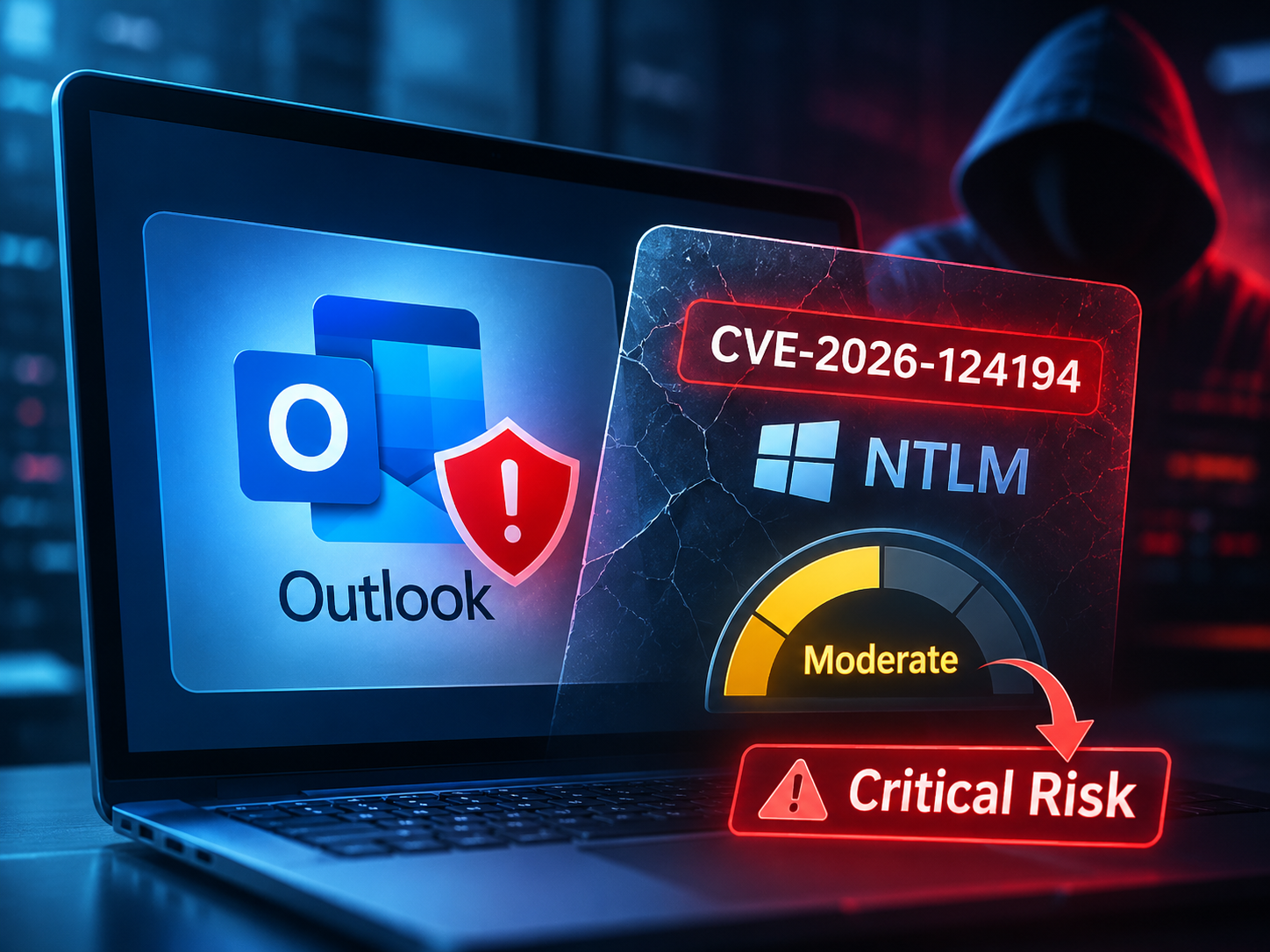
On 10 November 2026, Microsoft’s November Patch Tuesday fixed CVE-2026-124194, a spoofing vulnerability in classic Outlook for Windows. Microsoft has confirmed that it is exploited in the wild, and CISA added it to its Known Exploited Vulnerabilities catalog the same day with a remediation deadline of 24 November 2026. It is the only exploited vulnerability in the November release.
The practical takeaway is that the score undersells the risk. Microsoft rates the flaw Moderate with a CVSS 3.1 score of 6.5, yet a single opened message file is enough to send a user’s NTLMv2 hash to an attacker. That hash can be cracked offline or relayed to other services to impersonate the user. The fix also ships as an Office update rather than through Windows Update, so organizations that only patch the operating system can still be exposed.
This post explains how the vulnerability could be exploited, which builds are affected, what it means for organizations and what to do now.
How the vulnerability could be exploited
Outlook is meant to warn the user before it connects to an external network location. With this flaw, a crafted .msg or .oft message file makes classic Outlook reach out to a remote path without that warning. The connection normally uses SMB on TCP 445, or WebDAV over HTTP or HTTPS when the WebClient service is running, and both send the user’s NTLM credentials automatically. Microsoft has not said which part of the file holds the remote path, and it classifies the weakness as CWE-356, a user interface that does not warn about an unsafe action.
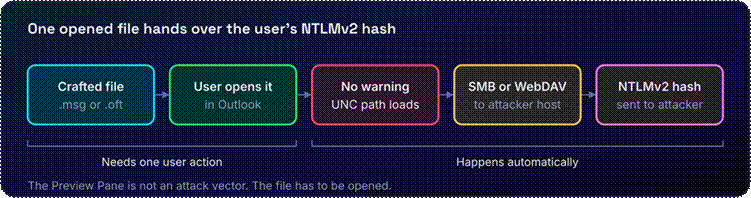
Figure 2. How one opened file leaks the user’s NTLMv2 hash
CVE-2026-124194: Outlook NTLM hash disclosure (exploited)
- Potential attack path: An attacker sends a crafted .msg or .oft file, most likely as an email attachment or a download link. When the user opens it, classic Outlook connects to the attacker’s server and Windows answers the NTLM challenge with the user’s NTLMv2 response. The Preview Pane is not an attack vector, so the file has to be opened.
- Potential impact: Weak or medium-strength passwords can be cracked offline and reused wherever the account signs in, including Microsoft 365 when the account syncs to Entra ID. The hash can also be relayed in real time to services that lack SMB signing, LDAP signing and channel binding, or Extended Protection for Authentication. Relayed to AD CS web enrollment, a privileged account can yield a certificate that survives a password reset.
- Security focus: Office patch levels, outbound SMB and NTLM traffic from workstations, and the relay paths inside the domain.
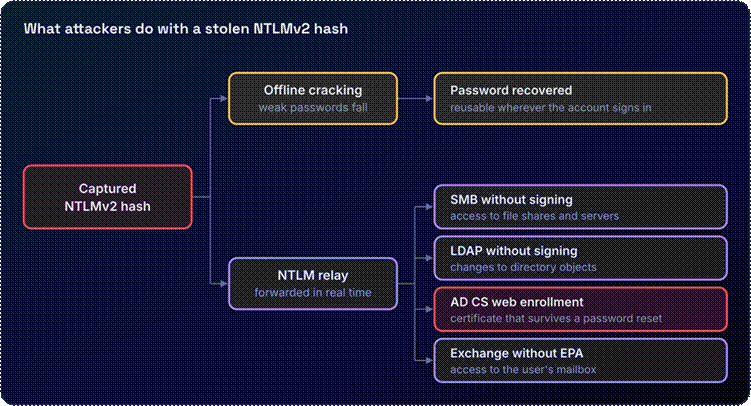
Figure 3. What attackers do with a stolen NTLMv2 hash
This is not the first Outlook flaw of its kind. CVE-2023-23397, fixed in March 2023, leaked NTLM hashes through a crafted calendar reminder without any user action, and it was used by APT28. For CVE-2026-124194, Microsoft has not disclosed the threat actor, targets or indicators of compromise. Public proof-of-concept status is also unclear: one vulnerability tracker lists proof-of-concept repositories, while other analyses found none as of 11 November.
These are potential risks, not proof of compromise. Organizations should treat any external NTLM authentication from Outlook as a signal worth investigating rather than assuming a breach.
Affected versions and fixed builds
| Product | Fixed build | Status (13 Nov 2026) |
| Microsoft 365 Apps, Current Channel (2610) | 20527.20196 | Fixed, released 10 Nov |
| Microsoft 365 Apps, Monthly Enterprise (2610) | 20527.20194 | Fixed, released 10 Nov |
| Microsoft 365 Apps, Semi-Annual Enterprise (2610) | 20527.20192 | Fixed, released 10 Nov |
| Office LTSC 2024 | 16.0.17932.21140 | Fixed, released 10 Nov |
| Office LTSC 2021 | 16.0.14334.21048 | Fixed, released 10 Nov |
| Office 2016 and Office 2019 | None | Out of support since October 2025, no fix |
| New Outlook, Outlook on the web | Not affected | Not listed by Microsoft |
| Outlook for Mac, iOS and Android | Not affected | Not listed by Microsoft |
The fix reaches PCs through Office’s Click-to-Run or volume licensing channels, not Windows cumulative updates. A team that patches only the operating system through WSUS or an OS update ring can finish the November cycle and still run a vulnerable Outlook.
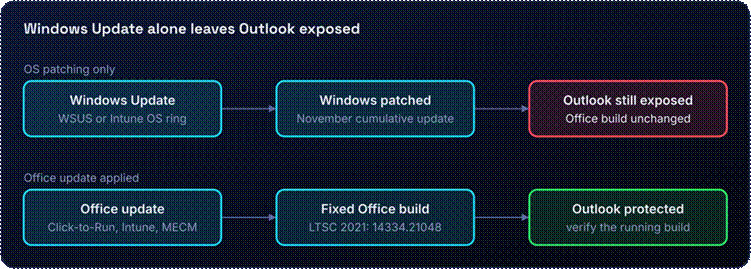
Figure 4. Why Windows Update alone does not fix Outlook
| Date | Event |
| 14 March 2023 | CVE-2023-23397 fixed, an earlier Outlook flaw that leaked NTLM hashes |
| 14 October 2025 | Office 2016 and Office 2019 reach end of support |
| 10 November 2026 | Fix released, exploitation confirmed and CVE added to CISA KEV |
| 24 November 2026 | CISA remediation deadline for US federal agencies |
What this issue means for organizations
- The score understates the risk: The 6.5 rating reflects the need for user interaction and a disclosure-only impact, but the flaw is confirmed exploited, needs no authentication and works with one opened file in an application almost every enterprise runs.
- OS patching is not enough: Because the fix ships through Office channels, a fleet can look fully patched in Windows reporting while Outlook remains vulnerable.
- Credential exposure beyond Outlook: A cracked password can be reused against Entra ID and Microsoft 365, so the impact reaches cloud mail, files and collaboration tools.
- Domain relay paths: Unsigned SMB and LDAP, AD CS web enrollment and Exchange without EPA turn a single leaked hash into a route toward domain-level access.
- Unsupported Office versions: Office 2016 and 2019 receive no fix, so any remaining installations stay exposed until they are upgraded or isolated.
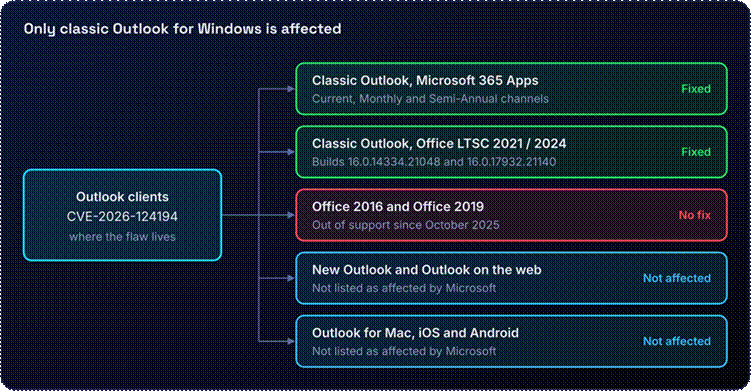
Figure 5. Which Outlook clients are affected
What organizations should do now
- Patch Office, then verify: Deploy the November 2026 Office build through Click-to-Run, Intune, MECM or the volume licensing channel, and confirm the running build on each PC matches the fixed versions above.
- Block outbound SMB: Block TCP 445 and 139 to the internet at perimeter and host firewalls, and stop the WebClient service on machines that do not need WebDAV.
- Restrict outgoing NTLM: Set the policy for outgoing NTLM traffic to remote servers to audit first, then deny with exceptions (RestrictSendingNTLMTraffic under HKLM\SYSTEM\CurrentControlSet\Control\Lsa\MSV1_0). Add privileged accounts to the Protected Users group so their NTLM hashes are never sent.
- Close relay paths: Enforce SMB signing, require LDAP signing and channel binding on domain controllers, and enable Extended Protection for Authentication on AD CS, Exchange and other IIS-hosted services.
- Hunt for leaks: Look for OUTLOOK.EXE connecting to TCP 445 on public addresses, rundll32.exe calling davclnt.dll,DavSetCookie toward external hosts, NTLM Operational event 8001 naming an external server, and NTLM logons from new sources. If a leak is likely, reset the password, revoke sessions and review AD CS for unexpected certificates.
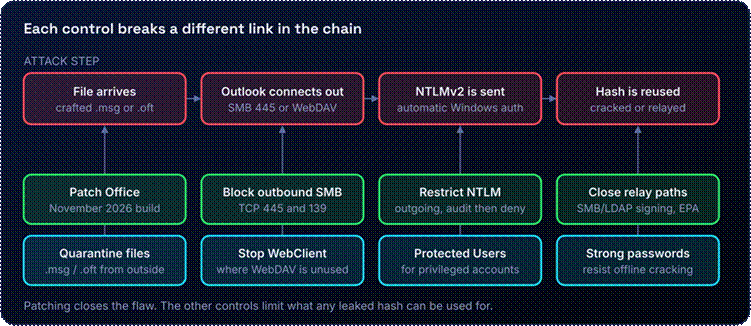
Figure 6. Each control breaks a different link in the attack chain
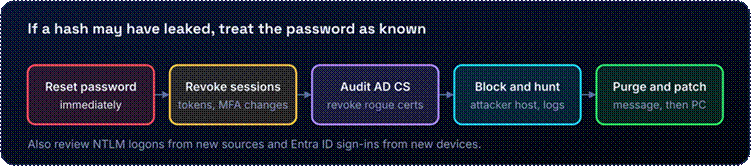
Figure 7. Response steps if a hash may have leaked
Conclusion: a moderate score, a critical exposure
CVE-2026-124194 shows that a Moderate rating can still hide a serious risk when a flaw is exploited and sits in software every user opens daily. Installing the November Office update and confirming the running build remains the main fix, with outbound SMB blocking and NTLM restrictions limiting what any leaked hash can do.
Sources and further reading
- Microsoft’s November 2026 Patch Tuesday addresses 1093 CVEs, Tenable
- Outlook CVE-2026-124194 NTLM Zero-Day: Patching and Hunting, ThreatDefence
- CVE-2026-124194: Actively Exploited Outlook Zero-Day Leaks NTLM Hashes, Decryption Digest
- Exploited Outlook CVE-2026-124194: Patch by November 24, Brandefense
- Microsoft Outlook Zero-Day CVE-2026-124194 Exploited in the Wild, SecurityOnline
- CVE-2026-124194 record and KEV details, ThreatInt