

Introduction
A critical security vulnerability in Apache HTTP Server could allow unauthenticated remote attackers to execute arbitrary code on affected web servers. Tracked as CVE-2026-119618, the flaw affects Apache HTTP Server versions 2.4.55 through 2.4.70 and originates from improper synchronization within the HTTP/2 module, mod_http2. Red Hat has assigned the vulnerability a CVSS score of 9.8, highlighting the potential severity of successful exploitation.
The vulnerability is a race condition in concurrent HTTP/2 request processing that can corrupt heap memory and potentially allow an attacker to execute commands with the privileges of the Apache server process. Apache addressed the issue in version 2.4.71, released on November 11, 2026. The concerning aspect is that an attacker does not require valid credentials or user interaction to target an exposed server. The flaw highlights an important infrastructure security risk: weaknesses in underlying web server components can compromise applications even when application-level security controls are properly implemented.
Understanding CVE-2026-119618
Apache HTTP Server is widely used to host websites, enterprise applications, APIs, and reverse-proxy services. Its HTTP/2 module improves performance by supporting multiplexing, allowing multiple requests and responses to be processed concurrently over a single connection.
However, concurrent processing requires proper synchronization between threads that access shared resources. The Apache advisory describes CVE-2026-119618 as concurrent execution using a shared resource with improper synchronization in the assign_headers() function of mod_http2. In practice, this is a race condition (CWE-362) that can corrupt heap memory and potentially compromise the execution flow of the web server process.
The flaw was found twice, independently. Anthropic’s OSS Scanner, an AI-based scanning service for open-source projects, reported it on October 26, 2026. Anthony Weems and Simon Scannell of Google Cloud Vulnerability Research reported it as well.
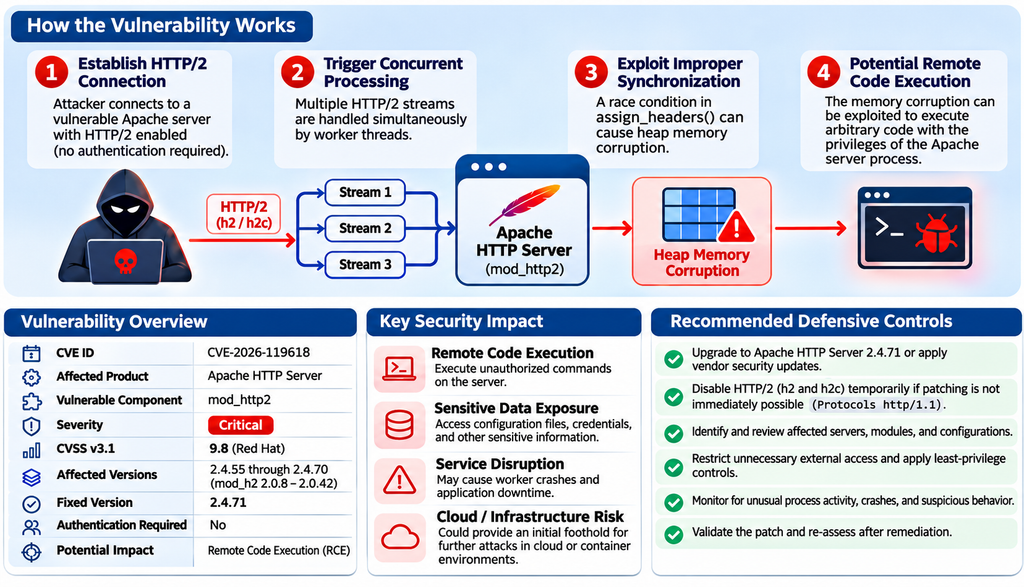
How the HTTP/2 Vulnerability Works
HTTP/2 allows multiple streams to operate simultaneously within a single connection. Apache handles these requests using worker threads that interact with shared connection-level resources.
In vulnerable versions, improper synchronization between these threads can create conflicting memory operations. Under certain conditions, this behavior can corrupt heap memory and potentially allow remote code execution.
The attack mechanism can be divided into four stages:
Stage 1: Establishing an HTTP/2 Connection. An unauthenticated attacker establishes a network connection to a vulnerable Apache HTTP Server with HTTP/2 enabled. No application credentials are required.
Stage 2: Triggering Concurrent Request Processing. The attacker interacts with HTTP/2 request-handling functionality, causing multiple streams to be processed concurrently by worker threads.
Stage 3: Exploiting Improper Synchronization. Within the assign_headers() processing path, concurrent operations on a shared resource are not adequately synchronized, which can corrupt heap memory.
Stage 4: Potential Remote Code Execution. If the attacker successfully exploits the memory corruption, arbitrary code may execute within the Apache server process. The resulting access depends on the privileges and security restrictions assigned to that process.
The vulnerability is especially significant because it exists at the web server protocol-processing layer rather than within a specific application feature. Consequently, application authentication controls do not necessarily prevent an attacker from reaching the vulnerable functionality.
Affected Versions and Infrastructure Exposure
CVE-2026-119618 affects Apache HTTP Server releases from 2.4.55 through 2.4.70, including standalone mod_h2 module versions 2.0.8 through 2.0.42. Servers patched in May for the earlier HTTP/2 flaw CVE-2026-23918 are still exposed, because versions 2.4.67 through 2.4.70 remain affected.
However, identifying an affected version is only the first step. Actual exposure also depends on whether HTTP/2 is enabled, whether the vulnerable functionality is reachable and whether the deployment includes a vendor-backported security fix.
The following Apache configuration enables HTTP/2:
Protocols h2 h2c http/1.1
h2 enables HTTP/2 over TLS, while h2c enables HTTP/2 over cleartext connections. These protocols may be configured globally or for individual virtual hosts.
Affected platforms and patch availability
The following status reflects publicly reported information as of November 12, 2026.
| Platform | Reported status | Remediation |
| Apache HTTP Server 2.4.55–2.4.70 | Vulnerable | Upgrade to 2.4.71 |
| Standalone mod_h2 2.0.8–2.0.42 | Vulnerable | No fixed release confirmed; project reported as archived. Disable HTTP/2 or move to the mod_http2 bundled with 2.4.71 |
| Red Hat Enterprise Linux 9 | Affected; fix released | mod_http2-2.0.26-7.el9_9.1 (RHSA-2026:98981) |
| Red Hat Enterprise Linux 10 | Affected; fix released | mod_http2-2.0.29-5.el10_3.1 (RHSA-2026:98978) |
| Red Hat Enterprise Linux 8 and earlier | Not affected | No CVE-specific fix required |
| Red Hat JBoss Core Services | Affected | No fix listed yet; monitor vendor advisories |
| Debian sid | Fixed | apache2 2.4.71-1 |
| Debian bookworm, trixie and forky | Vulnerable; fix pending | Monitor the Debian security tracker |
| Amazon Linux 2, 2023 and 2027 Preview | Affected; fix pending | Monitor security updates |
| Ubuntu | No status published yet | Monitor the Ubuntu security tracker |
Red Hat rates the vulnerability as Important rather than Critical for RHEL 9 and 10 because its packages give each HTTP/2 stream its own memory allocator, making exploitation much harder. This reduces exploitability but does not eliminate the need for security updates.
Apache 2.4.71 also fixes two smaller issues: CVE-2026-106023, a crash in mod_md rated Important, and CVE-2026-109163, a one-byte stack overwrite in mod_vhost_alias rated Low.
Organizations should also review container images, third-party software, reverse proxies, and cloud-hosted workloads that may include affected Apache components.
Detection: Identifying Vulnerable Apache HTTP/2 Deployments
Organizations should assess their Apache infrastructure to identify affected software versions, enabled HTTP/2 modules, and externally accessible services.
The following checks can support initial exposure identification.
Step 1: Identify the Apache version
Use the appropriate command for the operating system:
httpd -v
Or:
apache2 -v
Apache HTTP Server versions 2.4.55 through 2.4.70 require further investigation. For vendor-maintained distributions, package security advisories must also be checked because fixes may be backported without changing the upstream version number.
Step 2: Verify whether the HTTP/2 module is enabled
apachectl -M | grep -i http2
This identifies whether the HTTP/2 module is loaded. A loaded module does not, by itself, confirm that the vulnerable protocol is enabled.
Step 3: Review HTTP/2 protocol configuration
grep -Rin "Protocols" /etc/httpd/ /etc/apache2/ 2>/dev/null
Review the configuration for h2 and h2c entries, including settings associated with individual virtual hosts.
Step 4: Validate externally negotiated protocols
Where authorized, use an HTTP client to verify whether a published endpoint negotiates HTTP/2.
curl -sI --http2 -o /dev/null -w '%{http_version}\n' https://example.com
A result of 2 confirms that the tested endpoint negotiated HTTP/2. However, reverse proxies, CDNs, and load balancers may terminate connections before they reach the origin server, so external validation should be supplemented with host-level configuration review.
Recommended defensive controls
| Security layer | Recommended implementation |
| Patch management | Upgrade Apache HTTP Server to version 2.4.71 or apply vendor-provided fixes |
| Protocol hardening | Disable HTTP/2 temporarily where immediate patching is not feasible |
| Asset inventory | Identify affected Apache servers, containers, and bundled components |
| Configuration security | Review mod_http2, global protocol settings, and virtual-host configurations |
| Network security | Restrict unnecessary external access to origin servers and internal services |
| Least privilege | Limit Apache process permissions and access to sensitive resources |
| Runtime monitoring | Investigate unexpected worker crashes, process execution, and abnormal server activity |
| Security validation | Reassess affected systems after remediation and confirm the fixes are effective |
Conclusion
CVE-2026-119618 demonstrates how concurrency and memory-management weaknesses in widely deployed web server components can introduce critical security risks. A flaw in HTTP/2 request processing may allow unauthenticated attackers to corrupt server memory and potentially execute arbitrary code, creating opportunities for unauthorized access, sensitive information exposure, and service disruption.
For organizations operating Apache HTTP Server, identifying affected versions, reviewing HTTP/2 configurations, applying security updates, and validating remediation should be immediate priorities. Internet-facing systems and infrastructure supporting business-critical applications deserve particular attention.
Web server security must extend beyond application-level controls. Protocol implementations, server modules, operating-system permissions, and infrastructure configurations require continuous assessment to reduce the risk of compromise.
How CLEAR INFOSEC Can Help
CLEAR INFOSEC helps organizations strengthen their infrastructure security through Vulnerability Assessment and Penetration Testing (VAPT), Infrastructure Security Assessments, Web Application Security Testing, Cloud Security Assessments, configuration reviews, and cybersecurity advisory services.
For organizations operating Apache HTTP Server, focused security assessments can help identify vulnerable deployments, evaluate HTTP/2 exposure, review configuration and access controls, validate security patches, and prioritize remediation based on business risk.
Identify and address web infrastructure vulnerabilities before attackers exploit them.
Technical References
1. Apache Software Foundation – Apache HTTP Server 2.4 Security Vulnerabilities
2. Red Hat – CVE-2026-119618 Security Assessment