

Category: AI

  • A Futuristic AI Approach to Implement ISO 27001

    A Futuristic AI Approach to Implement ISO 27001

    ISO 27001 is widely regarded as the premier international standard for implementing an information security management system (ISMS). It provides a systematic approach to managing sensitive company information and defending against cyber threats.

    Artificial intelligence is transforming how organizations approach information security. AI and machine learning algorithms can process huge volumes of data, identify patterns and anomalies, simulate cyberattacks, and automatically respond to incidents. This enables companies to detect threats early, quickly analyze risks, and take corrective actions.

    AI is the perfect technology to incorporate into an ISO 27001 compliant ISMS. It can enhance risk management, monitoring, incident response and virtually every other process. AI can make ISO 27001 implementations scalable, efficient and adaptive. It allows understaffed security teams to cover more ground with fewer resources.

    In this comprehensive guide, we will explore the various ways artificial intelligence can be integrated at each step of the ISO 27001 implementation journey.
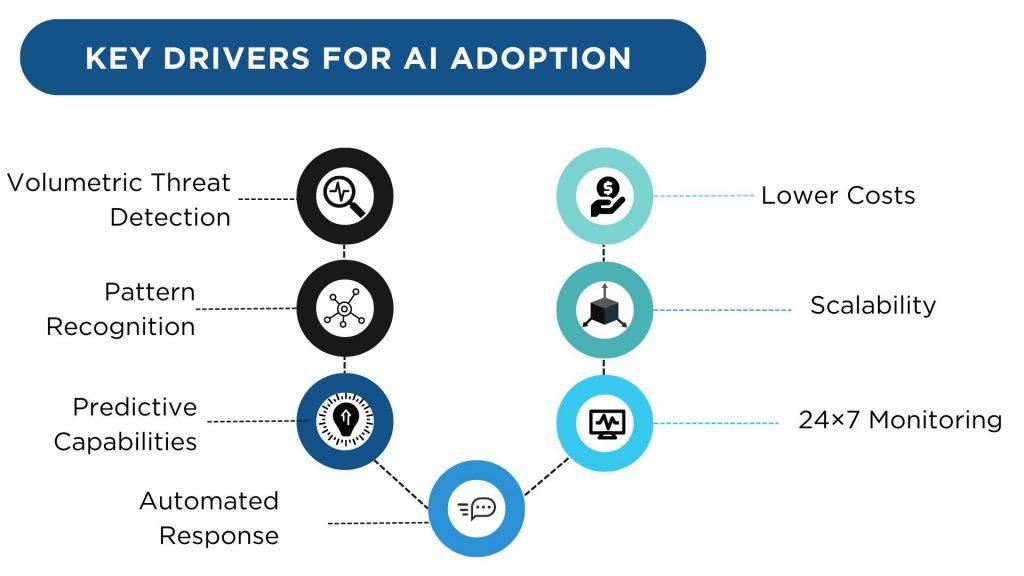
     

    Artificial intelligence promises tremendous benefits for information security:

    Volumetric Threat Detection:

    AI systems can process exponentially more data than humans. Even minor anomalies across massive datasets indicate threats that humans would likely miss. AI complements the human ability to detect sophisticated attacks by eliminating blindspots at volume.

    Pattern Recognition:

    By continuously analyzing huge volumes of data across diverse sources, AI algorithms uncover complex patterns in the noise that point to emerging threats. These would normally be invisible to human eyes. The broad data access of AI systems reveals tactics, techniques and procedures used by threat actors.

    Predictive Capabilities:

    Machine learning models can ingest data from inside and outside the organization to make highly accurate predictions of where the next threat may arise or how an attack may unfold. The risk of insider threats can also be anticipated by analyzing behavioral patterns. AI systems get better at predictions over time as more data is fed.

    Automated Response:

    When a threat surfaces, AI systems can instantly take routine response actions like blocking IP addresses or disabling accounts according to predetermined playbooks. This allows rapid containment before incidents spiral out of control. The machine speed of AI enables near real-time defenses.

    24×7 Monitoring:

    AI systems continuously monitor networks, endpoints, servers, logs, traffic, access and usage without downtime, distractions or fatigue. Machine learning models trained on large volumes of historical data are able to flag anomalies suggesting potential threats. This vigilant monitoring is impossible for human teams alone.

    Scalability:

    AI systems can easily scale up or down on demand to meet the security needs of growing networks and users. Once the upfront development and training of algorithms is complete, they can be flexibly deployed across on-premise and cloud environments. This scalability is especially beneficial for large enterprises.

    Lower Costs

    While the upfront investment in AI can be significant, the ongoing marginal costs are relatively low compared to recruiting, training and managing large teams of expert analysts. The computing costs required to run advanced AI algorithms also continue to fall steadily.

    These AI capabilities perfectly complement the rigorous requirements of ISO 27001 implementations. That makes AI an extremely appealing technology for enhancing ISMS defenses.
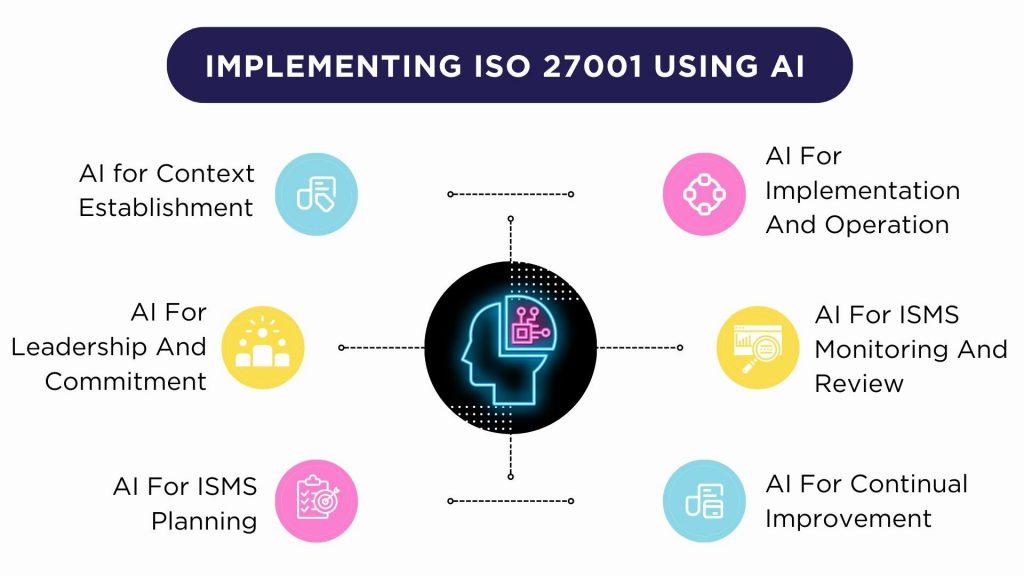
    1. AI for Context Establishment:

    • As per ISO 27001, organizations must determine the external and internal factors that can impact their ISMS as well as the requirements of interested parties. This establishes the context for information security risk management.
    • AI can help by automatically scanning the internal IT environment and external threat landscape. It creates an inventory of hardware, software, servers, endpoints, networks, firewalls, applications, databases and more.
    • Machine learning algorithms map out all internal IT connections and dependencies to create a visual topology. This highlights critical information assets and data flows. Graph databases track this complex web of relationships in an easily analyzable structure.
    • Externally, AI systems continuously monitor threat intelligence feeds, dark web forums, hacker chatter on social platforms, cybercrime marketplaces, hacktivist communities and more. Natural language processing reveals emerging threats, leaked credentials, zero-days and high-risk vulnerabilities likely to be exploited.
    • By processing millions of disparate internal and external data points, AI comprehensively establishes the information security context faster than human analysts ever could.

    2. AI for Leadership and Commitment:

    • ISO 27001 demands leadership commitment and formal policy mandates to engrain information security organization-wide. AI can assist executives in crafting effective policies, defining information security roles and responsibilities, setting goals and steering overall strategic direction.
    • Chatbots and virtual assistants can be programmed with domain expertise to provide sample policies, procedural templates, organization structures, training materials and guidelines tailored to the company’s needs.
    • These AI systems help leadership make wise strategic decisions during ISMS planning and ensure adequate executive oversight for the long-term. They allow efficient collaboration despite geographical spread of leaders.

    3. AI for ISMS Planning:

    • The standard requires organizations to identify assets, assess risks, select controls and develop an ISMS plan aligned to business objectives. AI helps automate identification of information assets using scanning, crawling and mapping techniques. Machine learning compares asset inventories over time to highlight changes.
    • Algorithms can also ingest intelligence feeds, conduct dark web scans, run ethical hacking simulations and model attack probabilities to systematically identify potential threats.
    • Combining asset and risk data, AI systems can recommend the most applicable controls from ISO 27001 Annex A to secure critical assets based on their sensitivity and exposure.
    • Automated planning tools can then assimilate this intelligence to create comprehensive ISMS implementation roadmaps covering phases, activities, schedules and resources. Dashboards allow tracking of plan progress.

    4. AI for Implementation and Operation:

    • ISO 27001 demands robust processes to implement and operate the ISMS according to plan. AI amplifies human capabilities during rollout by handling mundane tasks like configuring firewalls, deploying endpoint agents, setting access rules and installing hardware. This frees up security staff for high value tasks.
    • Cloud-based AI platforms provide centralized dashboards to seamlessly orchestrate and provision security controls across the entire IT environment. APIs integrate existing security products into a unified whole.
    • Powerful cybersecurity analytics, enabled by machine learning algorithms, automatically monitor activity across networks, systems, applications, databases and users. They quickly identify deviations suggesting potential breaches.
    • When threats strike, AI-based security orchestration, automation and response (SOAR) platforms can rapidly validate incidents, isolate impacted systems, kill unnecessary processes, eliminate user access and halt malware propagation. This minimizes damage.

    5. AI for ISMS Monitoring and Review:

    • The standard requires periodic monitoring, audits and reviews of ISMS effectiveness. AI is ideally suited for continuous around-the-clock performance monitoring versus intermittent human reviews. Virtual assistants can be assigned to perpetually measure KPIs like patch latencies, virus scan frequencies, encryption coverage, access request approvals and more.
    • Machine learning algorithms can randomly sample log, event and traffic data to identify potential control lapses. Natural language processing parses through emails, social media posts, chats and documents to detect high-risk behavior, misuse and policy violations.
    • AI significantly enhances auditing capabilities. Algorithms can methodically inspect network traffic, open ports, cloud configurations, access controls and system settings for deviations from ISO 27001’s best practices.
    • Intelligent dashboards populated by AI systems provide easy-to-digest security metrics, audit findings, risk scores, performance trends and benchmarks tailored to management and operator needs.

    6. AI for Continual Improvement:

    • The ISO standard mandates continual improvement based on objective measurements. Since AI systems perpetually ingest new external threat data combined with internal monitoring intelligence, they can constantly fine-tune risk models. This allows them to predict emerging threats earlier.
    • Machine learning algorithms analyze incident, audit and control data to systematically pinpoint where processes or technologies are falling short. This insight allows targeted enhancements to strengthen defenses.
    • Natural language AI can parse through employee and customer surveys, emails, chats and social media to gauge sentiment relating to information security practices. AI identifies strengths to double down on and weaknesses to fix.
    • Virtual assistants use aggregated performance data and sentiment analysis to provide customized recommendations to executives on ISMS improvements. Expert systems cost-benefit analyses help maximize return on security investments.


    Key Challenges and Limitations

    While AI offers many benefits for ISO 27001, there are some key challenges and limitations to consider:

    • Initial Integration Complexity – Integrating AI with legacy systems lacking APIs or cloud connectivity can be tricky for organizations without modern IT infrastructure. Migrating data securely to the cloud also poses challenges.
    • Unknown Threat Detection – Since AI learns from data patterns, completely unexpected new attack methods may go unrecognized until models are retrained after initial incidents. The black box nature of deep learning models also hampers analysis of blindspots.
    • Data Dependency – AI effectiveness is constrained by the quality and breadth of data inputs. Incorrect, biased or limited data skews results. Getting comprehensive data is critical.
    • Explainability Concerns – Complex machine learning models hamper audits of AI decision logic. Lack of transparency into how AIs arrive at conclusions can undermine trust. Oversight is key.
    • Complacency Risks – Overreliance on AI can lead to complacency and erosion of human expertise. Skilled professionals are still needed to interpret nuanced findings.
    • Adversarial Vulnerabilities – Hackers can manipulate data inputs or poison training data to deceive AI algorithms and trigger false alerts or dangerous actions. Defending against these adversarial attacks is challenging.


    The Future of AI in ISO 27001

    As AI adoption grows, it may become an integral part of future ISO 27001 revisions. Specific AI controls could be added to guide its use.

    With more implementations, large datasets will be aggregated to create industry-specific AI models. These shared models will spread the benefits to smaller companies lacking resources to train their own algorithms.

    In the long-term, autonomous AI security may shoulders a large part of day-to-day ISMS functioning with humans focused on strategic oversight. However, responsible oversight is necessary to check AI’s power and prevent unintended consequences.

    ISO 27001 helps organizations manage information securely. AI unlocks capabilities to take that security to the next level. But striking the right synergy between humans and AI is key to maximizing benefits while minimizing downsides.

    With the right strategy, processes and oversight, AI-powered ISO 27001 implementations can make information security management more predictive, proactive, scalable and resilient. This symbiosis fortifies defenses far beyond the capabilities of either humans or AI alone.

    In conclusion, integrating artificial intelligence into ISO 27001 information security management systems unlocks invaluable capabilities for proactive threat defense. AI adds machine power to human expertise to create a formidable cyber shield. Organizations that embrace this synergy will be well-positioned to thrive in the emerging era of cyber risk.

  • AI Revolutionizing Regulatory Compliance for Future Business Success

    AI Revolutionizing Regulatory Compliance for Future Business Success

    In an ever-evolving business landscape, staying compliant with regulations is crucial for long-term success. However, the traditional approach to regulatory compliance often involves manual processes that are time-consuming and prone to errors. Enter artificial intelligence (AI), a transformative technology that is revolutionizing the way businesses tackle compliance challenges. With its ability to analyze vast amounts of data, identify patterns, and automate repetitive tasks, AI has become an indispensable tool for ensuring regulatory compliance.

    The challenges of traditional compliance processes

    Traditional compliance processes have long been a burden for businesses of all sizes. The extensive paperwork, manual data entry, and complex regulatory frameworks make it a daunting task to navigate through compliance requirements. Moreover, the sheer volume of data that needs to be analyzed and monitored for compliance is overwhelming for human teams, leading to a higher risk of errors and omissions.

    One of the major challenges faced by businesses is the time-consuming nature of compliance processes. Compliance officers spend countless hours reviewing documents, conducting risk assessments, and ensuring adherence to regulations. This manual approach is not only inefficient but also leaves room for human error, which can have serious consequences for businesses. Additionally, the rapid pace of regulatory changes makes it even more difficult for compliance teams to stay up-to-date and ensure ongoing compliance.

    Another challenge lies in the ability to detect potential compliance violations in real-time. Traditional compliance processes often rely on retrospective analysis and audits, which means that violations may go unnoticed until it’s too late. This reactive approach not only increases the risk of penalties and fines but also damages the reputation of businesses. It becomes clear that a new approach is needed to streamline compliance processes and ensure proactive risk management.

    Overview of AI and its applications in various industries

    Artificial intelligence, often referred to as AI, is a branch of computer science that focuses on the development of intelligent machines capable of performing tasks that would typically require human intelligence. AI systems can analyze vast amounts of data, learn from patterns, and make decisions or take actions based on that data. This technology has seen rapid advancements in recent years and has found its applications in various industries, from healthcare to finance and now, regulatory compliance.

    In the healthcare industry, AI is being used to diagnose diseases, develop treatment plans, and even predict patient outcomes. In finance, AI-powered algorithms are used to analyze market trends, make investment decisions, and detect fraudulent activities. These are just a few examples of how AI is transforming industries by automating tasks, improving accuracy, and providing valuable insights.

    How AI is transforming regulatory compliance

    AI is revolutionizing the way businesses approach regulatory compliance by automating manual processes and providing real-time insights. One of the key areas where AI is transforming compliance is risk assessment. Traditionally, risk assessments involve manual reviews of various factors, such as financial records, customer data, and industry-specific regulations. This process is time-consuming and prone to errors. AI-powered systems, on the other hand, can analyze vast amounts of data in real-time and identify potential risks or compliance violations with a higher degree of accuracy.

    AI can also help businesses monitor ongoing compliance by continuously analyzing data and detecting anomalies or patterns that may indicate potential violations. For example, in the financial industry, AI algorithms can analyze transactions and detect suspicious activities that may be indicative of money laundering or fraud. By automating this process, businesses can identify and address potential compliance issues before they escalate, reducing the risk of penalties and reputational damage.

    Another area where AI is transforming compliance is in contract management. AI-powered contract analysis tools can review legal documents, identify key terms and clauses, and ensure compliance with regulatory requirements. This not only saves time but also reduces the risk of overlooking critical contractual obligations.

    Benefits of AI-powered compliance solutions

    The adoption of AI-powered compliance solutions offers a multitude of benefits for businesses. Firstly, it significantly reduces the time and effort required to ensure compliance. AI systems can analyze vast amounts of data in a fraction of the time it would take for a human team. This frees up valuable resources that can be redirected towards more strategic initiatives.

    Secondly, AI improves the accuracy and reliability of compliance processes. By automating tasks that were previously handled manually, the risk of human error is greatly reduced. AI systems can detect patterns and anomalies that may go unnoticed by human teams, allowing businesses to proactively address potential compliance issues.

    Furthermore, AI-powered compliance solutions provide real-time insights and alerts, enabling businesses to take immediate action when potential violations are detected. This proactive approach minimizes the risk of penalties and reputational damage, enhancing the overall compliance posture of businesses.

    Real-world examples of AI in regulatory compliance

    The application of AI in regulatory compliance is already yielding impressive results in various industries. For example, in the healthcare sector, AI-powered systems are being used to analyze electronic health records and identify potential instances of medical fraud or abuse. These systems can detect patterns and anomalies that may indicate fraudulent billing practices, allowing healthcare providers to take timely action and prevent financial losses.

    In the financial industry, AI is being used to detect money laundering activities and ensure compliance with anti-money laundering (AML) regulations. AI algorithms can analyze large volumes of transaction data and identify suspicious activities that may require further investigation. This not only helps businesses comply with regulatory requirements but also contributes to the overall fight against financial crime.

    Another real-world example of AI in compliance is its application in the field of data privacy and cybersecurity. With the increasing amount of sensitive data being collected and stored by businesses, ensuring compliance with data protection regulations has become a top priority. AI-powered systems can analyze data access logs, detect unauthorized access attempts, and provide real-time alerts when potential data breaches or compliance violations are detected.

    Key considerations when implementing AI in compliance processes

    While the benefits of AI in regulatory compliance are undeniable, there are several key considerations that businesses should keep in mind when implementing AI-powered solutions.

    Firstly, data quality and integrity are crucial for the success of AI systems. AI algorithms rely on accurate and reliable data to make informed decisions. Therefore, businesses need to ensure that their data is clean, up-to-date, and representative of the regulatory landscape they operate in. This may require investing in data cleansing and enrichment processes to improve the quality of the data used by AI systems.

    Secondly, transparency and interpretability are important factors to consider when implementing AI in compliance processes. AI algorithms often operate as black boxes, making it difficult to understand how they arrive at their decisions. This lack of transparency may raise concerns, especially in highly regulated industries where explain ability is crucial. Businesses should strive to implement AI systems that are as transparent as possible, allowing compliance officers and regulators to understand the rationale behind AI-driven decisions.

    Another key consideration is the ethical and legal implications of AI in compliance. AI systems, like any technology, can be vulnerable to biases and discrimination. It is important for businesses to ensure that their AI systems are trained on diverse and representative data to mitigate the risk of bias. Additionally, businesses should comply with applicable laws and regulations governing the use of AI, such as data protection and privacy laws.

    Ethical and legal implications of AI in compliance

    The adoption of AI in compliance raises important ethical and legal considerations. From an ethical standpoint, ensuring fairness and avoiding biases is crucial when using AI-powered solutions. AI algorithms learn from historical data, and if this data is biased or discriminatory, the AI system may perpetuate those biases. For example, in the hiring process, AI-powered systems may inadvertently discriminate against certain groups if the training data is biased towards a particular demographic.

    To address this issue, businesses should strive to use diverse and representative data when training AI systems. This can help mitigate the risk of bias and ensure that the AI system makes fair and unbiased decisions. Additionally, ongoing monitoring and auditing of AI systems can help identify and rectify any biases that may arise over time.

    From a legal standpoint, businesses must comply with applicable laws and regulations governing the use of AI in compliance. This includes data protection and privacy laws, which govern the collection, storage, and processing of personal data. Businesses should ensure that their AI systems are designed with privacy in mind and that they comply with relevant data protection regulations.

    The future of compliance: AI advancements and predictions

    The future of compliance is undoubtedly intertwined with AI advancements. As AI technology continues to evolve, we can expect even more sophisticated AI-powered solutions that will further streamline compliance processes and enhance accuracy.

    One of the key advancements in AI is natural language processing (NLP), which enables machines to understand and interpret human language. NLP can be used to analyze regulatory texts, identify relevant requirements, and automatically update compliance frameworks. This can greatly simplify the process of staying up-to-date with regulatory changes and ensure ongoing compliance.

    Additionally, machine learning techniques are constantly improving, enabling AI systems to learn and adapt in real-time. This means that AI-powered compliance solutions will become even more accurate and efficient over time, as they continuously learn from new data and feedback. This will further reduce the risk of false positives and improve the overall effectiveness of compliance processes.

    Another area of advancement is the integration of AI with other emerging technologies, such as blockchain. Blockchain technology provides a secure and transparent way to record and verify transactions, making it an ideal complement to AI-powered compliance solutions. By leveraging the immutability and traceability of blockchain, businesses can enhance the integrity and auditability of compliance processes.

    Conclusion: Embracing AI for successful regulatory compliance

    In conclusion, AI is transforming the future of compliance by automating manual processes, improving accuracy, and providing real-time insights. The challenges of traditional compliance processes, such as time-consuming tasks and the difficulty of detecting potential violations in real-time, are being addressed by AI-powered solutions. The benefits of AI-powered compliance solutions are clear: reduced time and effort, improved accuracy, and proactive risk management.

    While implementing AI in compliance processes, businesses need to consider data quality, transparency, and the ethical and legal implications of AI. Ensuring that AI systems are trained on diverse and representative data, complying with applicable laws, and promoting transparency are key to leveraging AI effectively and ethically.

    As AI continues to advance, the future of compliance looks promising. Natural language processing, machine learning improvements, and the integration of AI with other emerging technologies will further enhance compliance processes and provide businesses with the tools they need to navigate the ever-changing regulatory landscape with ease and confidence. Embracing AI for successful regulatory compliance is no longer a choice but a necessity for businesses seeking long-term success in the compliance-driven world.